
Hosted Bitcoin mining: the complete 2026 guide
Everything you need to know before getting started.
What hosted mining is
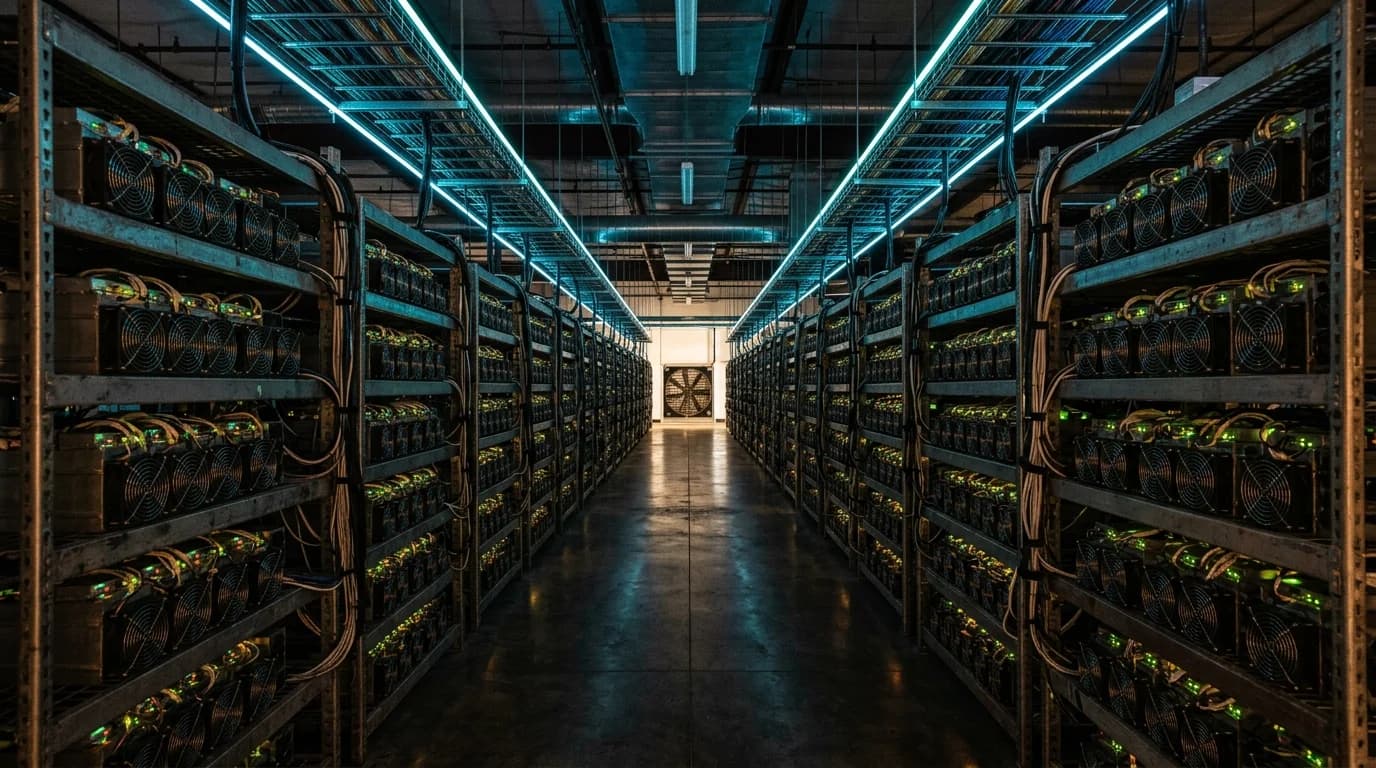
Hosted mining means buying an ASIC and handing its operation to a professional operator. That operator installs the machine in its datacenter and supplies electricity, connectivity, ventilation, and maintenance, against a monthly rent.
You remain the owner of the machine and receive all the bitcoin it mines, with the rent billed separately. Noise, dissipated heat, and power cuts become the operator's problem.
Why not at home
An Antminer S21 Pro runs at about 75 dB(A) continuously, the level of a vacuum cleaner that never stops, and dissipates 3.51 kW permanently, which means 84 kWh of heat per day to evacuate. That is impossible in an apartment and demanding in a house.
US residential electricity averages around $0.16/kWh. Gross margin on an S21 Pro hits zero at $0.150/kWh at the median 2026 hashprice: at home, the machine therefore loses money every day it runs in most markets. An operation targeting a reasonable payback looks for a rate under $0.08/kWh, which corresponds to a large industrial consumer or a datacenter sited where energy is in surplus.
How to read a hosting rate
This is the point that catches out the most buyers. Operators bill in two different units, and comparing them directly means nothing.
Some quote a price per kWh consumed, others a flat rate per kW per month on reserved power. The conversion is one division:
Price per kWh = rate per kW per month ÷ 730
The 730 is the number of hours in an average month. A rate of $75/kW/month therefore equals $0.103/kWh, and a rate of $0.07/kWh corresponds to $51/kW/month.
| Rate per kW/month | Equivalent per kWh |
|---|---|
| $51 | $0.070 |
| $58 | $0.080 |
| $66 | $0.090 |
| $73 | $0.100 |
| $88 | $0.120 |
Always run that conversion before comparing two quotes. A per-kW flat also carries a structural difference: you pay it even while the machine is off, during an RMA for instance, whereas per-kWh billing follows production.
For an S21 Pro at 3.51 kW, a rate of $75/kW/month gives a rent of $263 per month, or $8.66 per day. That rent covers electricity, connectivity, ventilation, preventive maintenance, and monitoring. It covers neither the machine purchase nor hardware failures, generally handled through manufacturer RMA while under warranty.
What a machine earns
Daily gross revenue depends on the machine's hashrate and the current hashprice, expressed in dollars per TH per day. Hashprice aggregates BTC price, difficulty, block subsidy, and transaction fees. It oscillates between $0.03 and $0.08 depending on market conditions.
The calculation for a 234 TH/s S21 Pro at a hashprice of $0.058:
- Daily gross revenue: 234 × 0.058 = $13.57
- Hosting rent at $75/kW/month: $8.66
- Daily net revenue: $4.91, so about $149 per month
At that pace, paying back the machine alone, around $6,000, takes about 41 months. The same calculation at an operator charging $0.07/kWh, meaning $51/kW/month, brings the rent down to $5.90 per day and the payback to 26 months.
That fifteen-month gap comes entirely from the negotiated rate. Which is why the conversion to $/kWh belongs before signing, not after.
Hashprice is also unstable: it swung between $0.03 and $0.12 across 2024 and 2025. Any projection stays conditional on its assumptions, and gets rebuilt each quarter.
The costs that add on
Setup fees, $100 to $350 per machine, billed once for installation and configuration. Ask for a breakdown of what they cover.
Shipping to the datacenter, $50 to $220 depending on weight and destination. For ten machines to Iceland, budget $1,300 to $2,200, plus transit insurance, which is rarely included.
Pool fees, 1 to 2 % of gross revenue. Some hosts impose their pool, others leave the choice. That clause deserves checking: an imposed pool deprives you of the comparison between your local hashrate and the counted hashrate, which is your only independent control.
How to choose a host
The rate, converted to $/kWh. Below $0.08/kWh, so $58/kW/month, the offer is competitive. Between $0.08 and $0.10, it sits in the market average. Above $0.10, meaning $73/kW/month, require a justification: premium energy, stable jurisdiction, or stronger contractual guarantees.
The commitment term. Six months is comfortable, twelve months standard, twenty-four months binding. Always check the early exit penalty, often set at half the remaining months, which turns a long commitment into a trap if hashprice collapses.
Energy traceability. A serious operator states its dominant source, hydro, geothermal, wind, natural gas, or grid mix. That is first of all a transparency signal: a site that cannot say where its energy comes from will not explain a rate increase either.
The cooling mode supported. Not every site accepts hydro machines, which require a dedicated water loop. That compatibility gets verified before buying the machine, not after delivery.
Our role
The Bitcoin Bay compares hosts, cross-checks ASIC specifications against available rates, and provides a written analysis on request. The final contract is signed directly between you and the operator.
The profitability estimates shown on the site are computed at the hashprice and exchange rate of the moment, and change daily.
How to start
On an exploratory budget under $7,000, one entry-tier machine hosted at an accessible site validates the model over twelve months before anything else is considered.
On a structured investment of $12,000 to $60,000, three to ten current-generation machines, hosted in Iceland or Paraguay for the energy rate, justify a prior audit to frame the file.
Above $120,000, the structure becomes multi-site, with a dedicated legal entity and direct rate negotiation with the host.
In every case the same rule applies: start small, measure for six months, then decide. The Bitcoin market is volatile and so are operating conditions, which makes any extrapolation from a single quarter unreliable.
Buy or compare through The Bitcoin Bay
The Bitcoin Bay is an independent business introducer: we list new ASICs sourced directly from manufacturers (Bitmain, MicroBT, Bitdeer, Canaan) and refurbished machines via verified reseller partners. Each model is paired with professional hosting options at our partner sites in Northern Europe and Paraguay.
No yield promises, no payment handled on our side — the transaction is signed directly with the chosen partner. CIF/AMF status not solicited.
Related reading
Monitoring a Miner: Tools and Metrics
Monitoring a miner means comparing what the machine reports to what the pool counts. The six families of signals to track, and how to read them without blaming the wrong cause.
ReadBitmain Logs and Kernel Panic: Diagnostics
Read a Bitmain controller's logs in time order, sort the motif into five families, and treat a kernel panic as a controller halt rather than a mining problem.
ReadStratum Jobs and clean_jobs
A Stratum job is a work contract, and the clean_jobs flag revokes it. The five causes of invalidation and what you can actually fix.
Read
Frequently asked questions
What is the minimum budget to get started?+
Plan for €3,000-5,000 minimum for a current-gen ASIC plus 12 months of hosting. Below that, the learning cost / revenue ratio is unfavorable. A Quick Review audit (€500) lets you validate that your budget matches a realistic project before any purchase.
Do hosted mining revenues need to be reported in France?+
Yes. Mined bitcoin is taxable as BNC (non-commercial income) for occasional activity, or BIC for habitual activity. Threshold and regime depend on volume. Consult a crypto-aware accountant before signing.
What is the lifespan of an ASIC?+
An ASIC remains profitable as long as its daily net revenue stays positive at the current hashprice. In practice: 2-4 years for current-gen models, but the obsolescence threshold shifts with each new generation. A 2022 S19 is now near the profitability edge on average electricity rates.
What happens if the host goes bankrupt?+
The machine remains your property and must be returned. Verify that the hosting contract explicitly includes a property separability clause and a reasonable recovery period. Prefer operators with at least a 3-year operational track record.
What's the difference between Iceland and Texas hosting?+
Iceland: stable geothermal, cold climate (partial passive cooling), EU jurisdiction for most operators. Texas: wind and solar dominant, more volatile pricing but often lower rates, summer grid stress. The choice depends on pricing stability vs average rate.
Can you resell an ASIC mid-contract?+
Generally yes. The hosting contract follows the hardware, not the owner — resale is possible but must be notified to the host. Check the contract for any transfer clauses (administrative fees, new-owner validation).

slashbin
Builder depuis 2011. J'ai déployé et suivi en direct plusieurs vagues d'ASIC en hosting professionnel sur des sites en Europe du Nord, traversé les halvings au fil des années. Sur The Bitcoin Bay, je pose les chiffres réels, je casse les hypothèses dangereuses, et je mets en relation des projets sérieux avec des hébergeurs vérifiés. Pas de promesse de rendement.
- · Mineur depuis 2011
- · Suivi de déploiements ASIC en hosting professionnel
- · Veille marché ASIC + hashprice hebdomadaire