
Technical
Difficulty, SHA-256, firmware, OS configuration — going deeper.
Stratum Jobs and clean_jobs
A Stratum job is a work contract, and the clean_jobs flag revokes it. The five causes of invalidation and what you can actually fix.
3 min
Read articleAll articles
- Article
Causes of Rejected Shares
Stale, duplicate, target not met, drifted clock: the four families of rejects, how to tell them apart in a dashboard, and the procedure to isolate the cause.
3 min - Article
Miner Uptime and Drops: Maximizing Operating Time
Useful uptime is the time a machine hashes work the pool accepts. The six links in the chain, and the method for finding which one broke.
3 min - Article
Clock, Voltage, and Overclocking Risks
Clock and voltage are set together or not at all. The six concrete risks of an off-envelope profile, and the procedure for testing a change without losing a board.
3 min - Article
Heat, Airflow, and Thermal Derating
An ASIC turns nearly all its electricity into heat. Bad airflow makes firmware derate and the sticker hashrate disappears. How to spot the cause and fix it.
3 min - Article
ASIC Cooling: Air, Hydro, and Immersion
Air, hydro and immersion each move the constraint somewhere else: noise, water, chemistry, building. The concrete criteria for deciding on your site.
5 min - Article
ASIC Power Supply: PSU and Electrical Considerations
A miner PSU is a server-style brick: high-current rails, OVP/OCP/OTP trips, strict matching to the model. What to check before plugging in.
4 min - Article
Hashboard vs Control Board: ASIC Anatomy
Hashboards produce the hashrate, the control board talks to the pool. Telling the two roles apart stops you ordering the wrong spare.
3 min - Article
Coinbase and Miner Work: Building Mining Work
The coinbase creates the reward and carries the extraNonce. Change one byte and the Merkle root changes, so the header changes, and the miner's search space reopens.
3 min - Article
ASICBoost: Hardware Mining Optimization
ASICBoost reorders SHA-256 work to share more computation across tries. What it actually changes for an operator, and how to check version rolling on your machines.
3 min - Article
nBits and Target: Understanding Difficulty Encoding
nBits encodes the difficulty target in 4 bytes inside the header. Target, network difficulty, and share difficulty are three distinct objects, and confusing them skews the diagnosis.
3 min - Article
Stratum V1 vs Stratum V2: Protocol Evolution
Stratum v1 lets the pool build the block over a cleartext channel. Stratum v2 encrypts the channel and, depending on mode, lets the miner choose its transactions.
3 min - Article
Midstate: SHA-256 Hashing Optimization
Midstate is the SHA-256 state after the first 64 bytes of the header. It avoids recomputing the prefix on every nonce, and expires as soon as the Merkle root changes.
3 min - Article
Bitcoin Block Header: Structure and Fields
The 80-byte header is the only object the machine hashes. Version, prevhash, Merkle root, nTime, nBits, nonce: what each field allows, and which ones the miner can move.
3 min - Article
Shares and Latency: Understanding ASIC-Pool Communication
A share proves work to the pool, latency decides how long that work stays valid. What drives stales up, and the five measurements to take on one window.
3 min - Article
Bitmain Stock OS vs Custom Firmware: Which to Choose?
Stock firmware favours warranty and the vendor path, custom firmware favours fine control and telemetry. The six risks to weigh and the five questions to ask before flashing.
3 min - Article
Bitcoin Difficulty Explained
Difficulty retargets every 2016 blocks to hold a ten-minute block time. What it changes for your revenue, and the most common calculation traps.
3 min - Article
SHA-256: Bitcoin's Mining Algorithm
Mining is hashing an 80-byte header twice until it falls under the network target. Pools, shares and firmware sit on top of that loop.
3 min  ASIC Fundamentals
Bitcoin ASIC Specs Explained: TH/s, Watts, J/TH, Price
Hashrate, watts, J/TH, $/TH: the four specs that decide a purchase, plus the calculation for the kWh price above which a machine stops earning.
4 min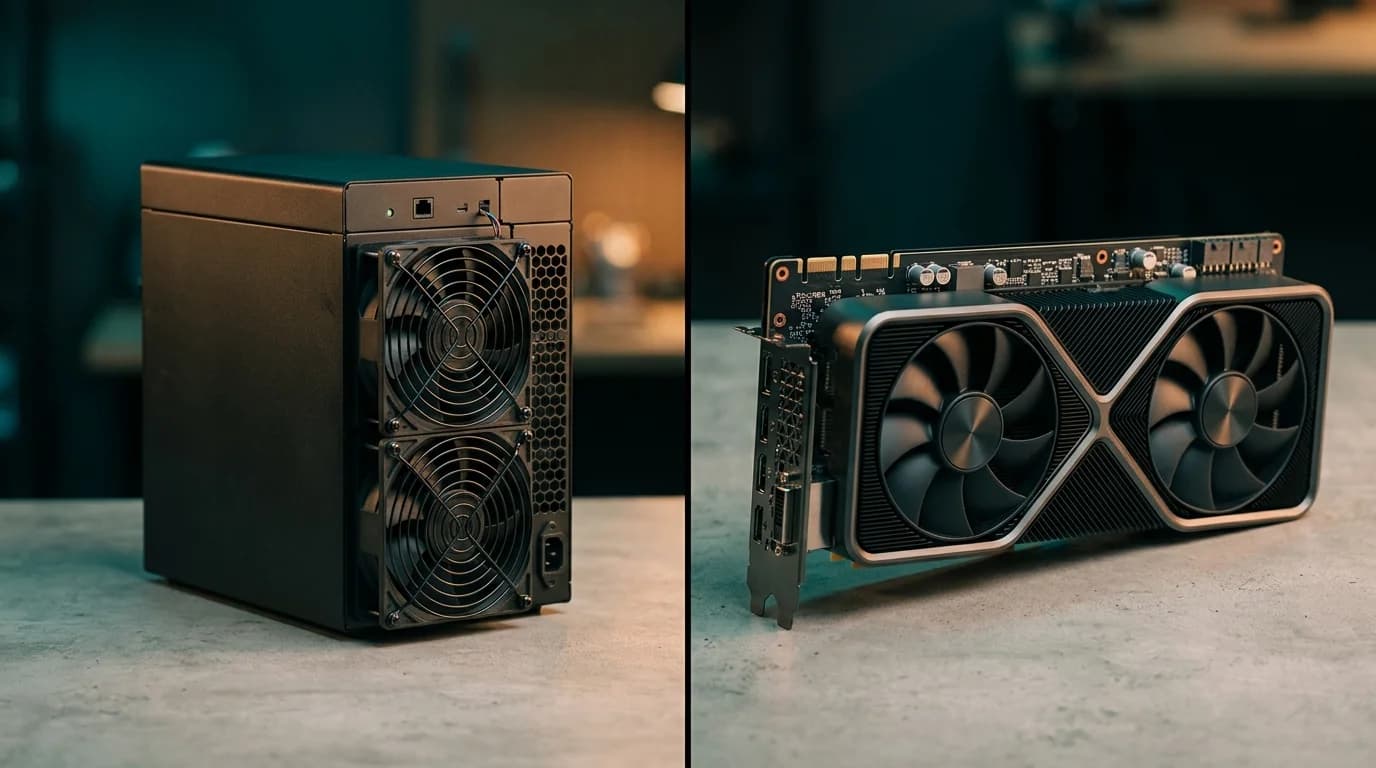 ASIC Fundamentals
ASIC vs GPU for Bitcoin Mining: Why GPUs Died in 2014
A modern ASIC pushes 234 TH/s, the best consumer GPU about 1 GH/s. That is 234,000 to 1 on hashrate and 30,000 to 1 on efficiency. GPUs keep a use on other networks, not on Bitcoin.
3 min