
Hosted Mining vs Home Mining: Which Wins?
Neutral comparison with 3 cases where home still wins.
In short. The rule fits on one line: a rate under $0.12/kWh, genuine tolerance for noise and heat, and no more than one or two air-cooled machines make home viable. Above $0.15/kWh, from three machines up, or with a hydro ASIC, hosting is the only option. In most residential markets, the first condition is rarely met.
Three questions that settle it
Before any detailed comparison:
- Is your real rate per kWh, taxes and delivery included, below $0.12? Margin hits zero at $0.150, so under $0.12 you keep a safety buffer against a hashprice drop.
- Can you dedicate a space that absorbs 75 dB(A) and 3.5 kW of heat continuously, across the machine's three-plus years of useful life?
- Does your electrical installation carry 16 A continuously on a dedicated circuit?
Three yeses make home viable. Two or more noes rule it out.
The twelve-month comparison
Antminer S21 Pro, median 2026 hashprice, accounting for the uptime actually observed in each configuration.
| Line | Home, $0.16/kWh | Hosted, $0.07/kWh |
|---|---|---|
| Average uptime | 92 % | 98 % |
| Annual gross revenue, uptime applied | $4,322 | $4,604 |
| Annual consumption | 28,288 kWh | 30,133 kWh |
| Electricity cost | −$4,526 | −$2,109 |
| Pool fees, 1.5 % | −$65 | −$69 |
| Setup fee | not applicable | −$150 |
| First-year result | −$269 | +$2,276 |
| Noise in your space | 75 dB continuous | none |
| Heat to evacuate in your space | 3.5 kW | none |
The annual gap therefore reaches about $2,545 on a single machine, most of it from the electricity rate and the rest from the six extra points of uptime.
What home actually involves
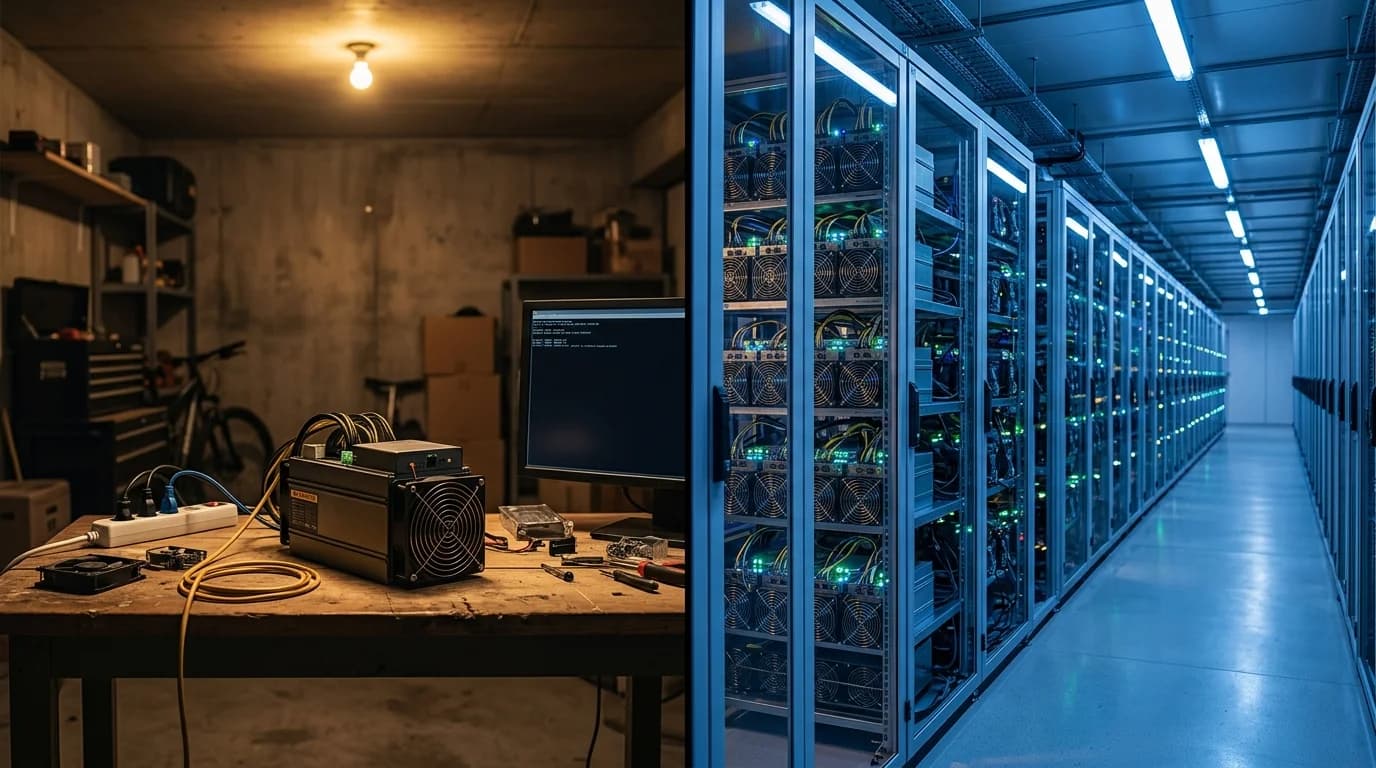
Noise. 75 dB(A) continuously is equivalent to a vacuum cleaner that never stops. That is unacceptable in an apartment, for neighbours as much as for sleep. In a house it stays workable with a closed garage, an isolated outbuilding, a ventilated basement, or a dedicated room away from bedrooms.
Three mitigations exist: a sound enclosure, around $500 for roughly 15 dB gained; an outdoor installation, which removes about thirty decibels on the neighbour's side; and underclocking, which reduces noise at the cost of hashrate. None makes an air-cooled machine compatible with multi-unit housing.
Heat. 3.5 kW is the equivalent of three convector heaters running permanently. In winter, in an electrically heated home, the machine replaces that heating while producing BTC, which is the only configuration where the home calculation turns favourable. In summer you either air-condition, adding its own cost, or move the machine, which assumes you planned a fallback location.
Electrical installation. 3.5 kW continuous is about 16 A at 230 V, or roughly 30 A at 120 V. A standard residential panel carries it, but with thin margin. Plan a dedicated 16 to 20 A circuit, its own breaker, and cabling rated for a continuous load. Budget $300 to $900 of electrical work depending on configuration, before buying the machine. A non-compliant installation on a permanent 16 A load carries a real overheating risk.
Failures. A power cut triggers no automation: restarting happens when you get back. A firmware crash needs manual intervention. Local overheating causes thermal derating that surfaces nowhere and quietly costs hashrate. That is what explains the 92 % uptime used in the table, against 98 % at a professional site.
What hosting changes
Industrial cooling is sized for continuous full-load operation, which removes summer derating. Supervision is automated, with alerts and restarts requiring nothing from you. The kWh rate is halved or better through industrial negotiation. Uptime carries a contractual commitment. And noise, heat, and electrical compliance leave your premises entirely.
In exchange: setup fees of $100 to $350, a six to twelve month commitment, and an early exit penalty whose amount you check in the contract.
Three cases where home still wins
Excess solar self-consumption. Your array produces more than you consume, and that surplus would export at a rate often below $0.10/kWh. Diverting it to a miner monetizes it better, at a marginal cost close to zero. It is the only case where home beats hosting on cash terms.
Mining as heating during the cold season. From October to March, if you heat electrically, producing that kilowatt through an ASIC that also generates BTC beats a passive heater. Out of season the machine has to stop, which cancels part of the annual return. A realistic setup therefore plans a summer location, which is not trivial to find.
Small-scale testing. A Bitaxe around $150, at 1 or 2 TH/s for 15 W, or a used Antminer S9, lets you learn the full ecosystem without commitment. Noise stays moderate and consumption low. The goal is understanding the chain, not earning.
Three cases where hosting is the only option
A hydro-cooled ASIC, S21 XP Hyd, S23 Hyd, or M66S Hydro, requires an industrial water loop no domestic installation provides.
A fleet above two machines, so beyond 7 kW continuous, exceeds what residential ventilation evacuates and what a domestic panel supplies.
An apartment or multi-unit building, where 75 dB and 3.5 kW of heat create a nuisance risk on top of the operational one.
Further reading
- Hosted bitcoin mining
- Bitcoin mining colocation cost
- Bitcoin mining electricity cost
- Our hosting offers
Mining involves a risk of capital loss.
Buy or compare through The Bitcoin Bay
The Bitcoin Bay is an independent business introducer: we list new ASICs sourced directly from manufacturers (Bitmain, MicroBT, Bitdeer, Canaan) and refurbished machines via verified reseller partners. Each model is paired with professional hosting options at our partner sites in Northern Europe and Paraguay.
No yield promises, no payment handled on our side — the transaction is signed directly with the chosen partner. CIF/AMF status not solicited.
Related reading
Hosted Mining (core business)
Hosted Bitcoin mining
You buy the machine, a company racks it and bills you for space and power. That is colocation, not cloud mining. What to read in the contract.
ReadHosted Mining (core business)
Bitcoin Mining Colocation Costs: Pricing Breakdown
From $0.055 to $0.10/kWh, plus $100 to $350 of setup. On an S21 Pro, $1,850 to $3,250 per year. The three billing models and the negotiation levers.
ReadHosted Mining (core business)
Cloud Mining vs Colocation: The Real Difference
Cloud mining rents unverifiable hashpower you never own. Colocation means you own the ASIC and an operator hosts it. The risk profiles are not comparable.
Read
Frequently asked questions
Should you host or mine at home?+
Simple rule: kWh < $0.10 AND noise/heat tolerance AND no more than 1-2 air ASICs → home viable. Above $0.12/kWh OR fleet > 2 machines OR hydro ASIC → hosting near-mandatory. In most US/EU cases, hosting is rational.
How loud is an ASIC?+
~75 dB continuously for current-gen air machines (vacuum cleaner volume). Hydro versions are quieter machine-side (~50 dB) but the manifold remains noisy. Incompatible with apartments, challenging in houses without a dedicated isolated room.
How much power does an ASIC draw at home?+
An Antminer S21 Pro draws 3.5 kW continuous — equivalent to 3 space heaters. Requires a dedicated 16A circuit (ideally 20A) with its own breaker. Budget $300-$800 for compliant electrical install.
At how many ASICs does hosting become mandatory?+
Beyond 2 ASICs at home (10+ kW continuous), residential electrical constraints become problematic. Professional hosting becomes economically and operationally necessary from the 3rd ASIC, or from the 2nd if you're in an apartment or shared housing.
Does home mining make sense in 2026?+
Three legitimate cases: 1) solar self-consumption excess (marginal kWh ≈ $0), 2) mining-as-heating in heating season, 3) test setup with a small machine (Bitaxe, used S9). Outside these cases, professional hosting is the rational choice.
- [1]Eurostat — EU residential electricity rates
Accessed on 17 mai 2026
- [2]US EIA — state residential electricity rates
Accessed on 17 mai 2026
- [3]Bitmain — Antminer noise & thermal specifications
Accessed on 17 mai 2026
- [4]Cambridge Bitcoin Electricity Consumption Index (CBECI)
Accessed on 24 mai 2026
- [5]Mempool.space — Bitcoin block explorer & network stats
Accessed on 24 mai 2026

slashbin
Builder depuis 2011. J'ai déployé et suivi en direct plusieurs vagues d'ASIC en hosting professionnel sur des sites en Europe du Nord, traversé les halvings au fil des années. Sur The Bitcoin Bay, je pose les chiffres réels, je casse les hypothèses dangereuses, et je mets en relation des projets sérieux avec des hébergeurs vérifiés. Pas de promesse de rendement.
- · Mineur depuis 2011
- · Suivi de déploiements ASIC en hosting professionnel
- · Veille marché ASIC + hashprice hebdomadaire