
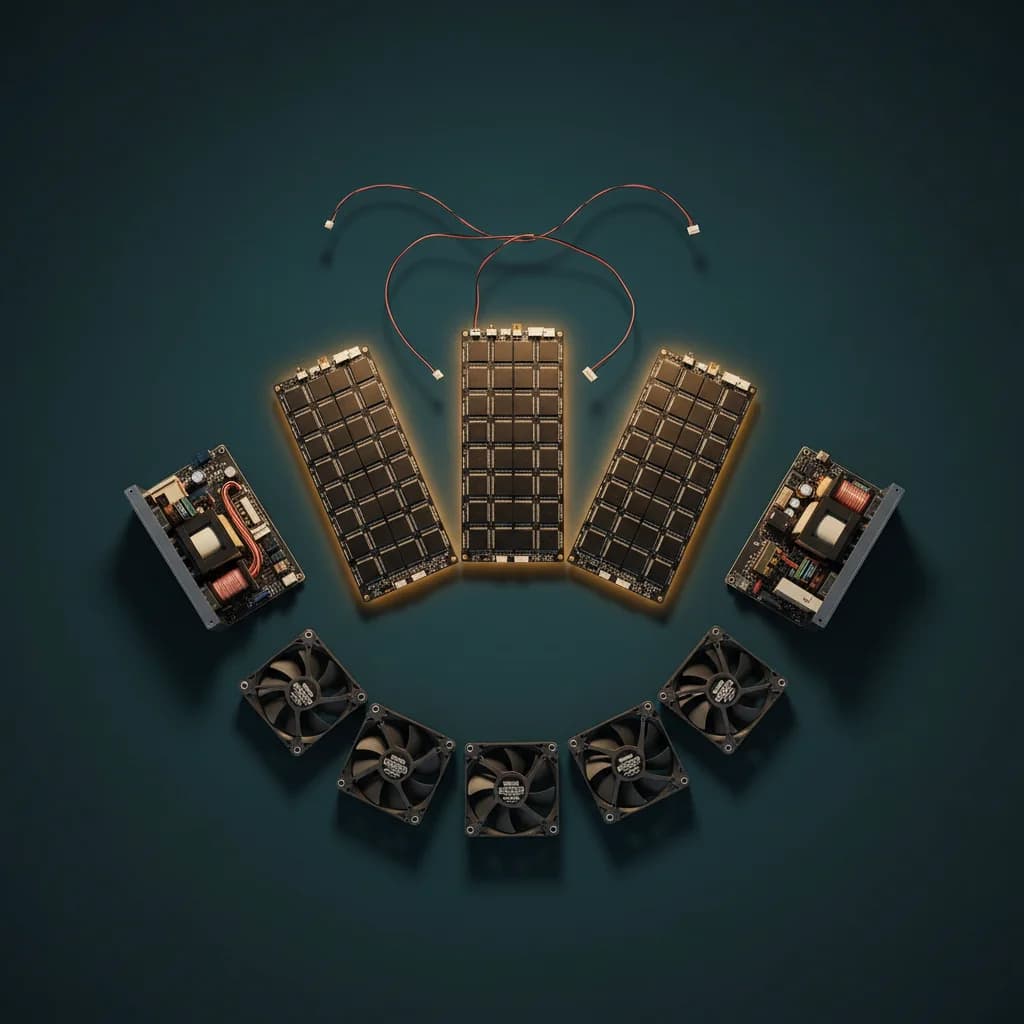
Bitcoin ASIC Specs Explained: TH/s, Watts, J/TH, Price
Decoding an ASIC datasheet: what each number means and what to target in 2026.
Hashrate (TH/s)
Hashrate is the number of SHA-256 hashes a machine computes per second. It is the most visible metric: higher hashrate, bigger proportional slice of the blocks the pool finds.
The 2026 standard unit is the terahash per second (TH/s): 1 TH/s is 10¹² hashes per second, one trillion. Current machines run from 100 TH/s at the legacy entry tier to 1,160 TH/s for a hydro flagship.
A few benchmarks:
- Antminer S19j Pro+: 122 TH/s
- Whatsminer M60S: 172 TH/s
- Antminer S21 Pro: 234 TH/s
- Antminer S21 XP Hyd: 473 TH/s
- Antminer S23 Hyd: 580 TH/s
- Antminer S23 Hyd 3U: 1,160 TH/s
Doubling hashrate on an equivalent machine doubles theoretical revenue, but also the watts and the purchase price. That is why hashrate alone never compares two machines: the next two specs decide the outcome.
Power (W)
Power is wall-plug draw, what your meter records while the machine runs. It is expressed in watts or kilowatts.
A modern machine draws between 1,800 W at the entry tier and 5,500 W for a hydro flagship, continuously, around the clock. Over a 730-hour month:
- 1,800 W, so 1,314 kWh per month, so $85 at $0.065/kWh
- 3,850 W, so 2,810 kWh per month, so $183 at $0.065/kWh
- 5,500 W, so 4,015 kWh per month, so $261 at $0.065/kWh
At US residential rates, around $0.16/kWh, those amounts multiply by roughly two and a half, which is enough to explain why home mining loses money outside very cheap utility markets. See Hosted Bitcoin Mining.
The power a manufacturer advertises is a nominal figure. In practice, wall draw varies by about 5% with temperature, PSU efficiency, and firmware. To compare two machines, always divide power by hashrate.
Efficiency (J/TH)
Efficiency is the ratio of power to hashrate, expressed in joules per terahash (J/TH). A lower J/TH means fewer watts per hash produced, so more margin against electricity.
2026 benchmarks:
- 9 to 12 J/TH: hydro flagships, with the S23 Hyd and S23 Hyd 3U at 9.5 J/TH and the S21 XP Hyd at 12.0 J/TH.
- 13 to 17 J/TH: mainstream air, with the S21 Pro at 15.0 J/TH and the S21 at 17.5 J/TH.
- 18 to 25 J/TH: entry-tier air, with the M60S at 18.8 J/TH.
- Above 25 J/TH: legacy machines, economically obsolete unless electricity is very cheap. The S19j Pro+, at 27.5 J/TH, belongs in this bracket despite its attractive sticker price.
The calculation that decides: break-even kWh
J/TH becomes usable the moment you convert it into the electricity price above which the machine stops earning. The calculation takes three lines.
A 16 J/TH machine draws 16 W per TH. Over 24 hours that is 0.384 kWh per TH per day. At a hashprice of $50/PH/day, the 2026 benchmark, each TH earns 50 ÷ 1,000 = $0.05 per day. The kWh price that wipes out the margin is therefore 0.05 ÷ 0.384 = $0.13/kWh.
Run it again at 30 J/TH: 0.72 kWh per TH per day, and a break-even of 0.05 ÷ 0.72 = $0.069/kWh. The same machine goes underwater twice as early.
That threshold is what you compare against your real rate, hosting included. An S21 Pro, rated at 15 J/TH, draws 0.36 kWh per TH per day: at a host charging $0.065/kWh it clears about $0.027 per TH per day, close to $6.30 a day across its 234 TH. At $0.16/kWh, the same machine loses money every day it runs.
The threshold moves with hashprice: rerun the calculation with the current value before any purchase.
Price and payback
Price compares in dollars per terahash ($/TH), obtained by dividing machine price by hashrate. It is the only way to compare machines of different sizes.
2026 benchmarks:
- Under $25/TH: an excellent deal, worth taking if efficiency follows.
- $25 to $35/TH: standard price on recent new gear.
- $35 to $50/TH: the top of the range, justified only below 12 J/TH.
- Above $50/TH: overpriced, short of a very limited production run.
Example: an S21 Pro at $6,000 divided by 234 TH gives $25.6/TH. A new S19j Pro+ at $3,250 divided by 122 TH gives $26.6/TH. The two prices look alike, but the second runs at 27.5 J/TH: its break-even falls below $0.08/kWh, and operating cost erases the purchase-price gap within months.
Payback, meaning the number of months to recover the investment, depends on hashprice, your electricity rate, and hosting cost. See Bitcoin Mining Profitability 2026 for the full method.
Noise, dimensions, cooling
These three specs decide where a machine can be deployed, and they are the ones most often discovered too late.
Noise. An air-cooled machine produces 70 to 80 dB(A) at full load, the equivalent of a continuously running lawn mower. That is incompatible with a residential setting without heavy soundproofing. Hydro machines drop to 45 or 55 dB(A), at the cost of a cooling loop to install.
Dimensions and weight. A standard ASIC measures roughly 400 × 200 × 300 mm and weighs 14 kg. A 3U unit such as the S23 Hyd 3U measures 900 × 486 × 132 mm. Check compatibility with your host's 19-inch racks before ordering.
Cooling type. Air offers the simplest deployment with integrated fans. Hydro, with a cold plate and a water loop, is quieter and more efficient but demands dedicated infrastructure. Immersion, with the machine submerged in dielectric fluid, gives the best thermal performance for the heaviest deployment effort.
That choice conditions the choice of hosting site, since not every site accepts all three modes. See the Bitcoin ASIC guide, "How to start" section.
Disclaimer: Bitcoin mining carries a risk of capital loss. The figures above are 2026 references and evolve with hashprice and each new hardware generation.
Buy or compare through The Bitcoin Bay
The Bitcoin Bay is an independent business introducer: we list new ASICs sourced directly from manufacturers (Bitmain, MicroBT, Bitdeer, Canaan) and refurbished machines via verified reseller partners. Each model is paired with professional hosting options at our partner sites in Northern Europe and Paraguay.
No yield promises, no payment handled on our side — the transaction is signed directly with the chosen partner. CIF/AMF status not solicited.
Related reading
ASIC Fundamentals
ASIC vs GPU for Bitcoin Mining: Why GPUs Died in 2014
A modern ASIC pushes 234 TH/s, the best consumer GPU about 1 GH/s. That is 234,000 to 1 on hashrate and 30,000 to 1 on efficiency. GPUs keep a use on other networks, not on Bitcoin.
ReadASIC Fundamentals
What Is a Bitcoin ASIC?
A Bitcoin ASIC is a chip dedicated to SHA-256 hashing. It does nothing else, at a speed no other hardware reaches, and it goes obsolete in 24 to 36 months.
ReadMonitoring a Miner: Tools and Metrics
Monitoring a miner means comparing what the machine reports to what the pool counts. The six families of signals to track, and how to read them without blaming the wrong cause.
Read
Frequently asked questions
What is hashrate (TH/s)?+
The number of SHA-256 hashes computed per second. 1 TH/s = 10^12 = one trillion. Higher = bigger slice of pool rewards.
Why is J/TH crucial?+
It's the power-to-hashrate ratio that drives real-world profitability. Lower J/TH means less electricity per hash, so higher gross margin.
What J/TH should I target in 2026?+
Under 18 J/TH for new deployments. Under 12 J/TH for hydro flagships. Above 25 J/TH = obsolete unless very cheap electricity.
How much electricity does an ASIC use?+
From 1,800 W (entry) to 5,500 W (hydro flagship). Over a month (730 h) at $0.065/kWh, that's between $85 and $261 in electricity.
What is $/TH?+
Machine price divided by hashrate. Market yardstick: under $35/TH = excellent, $35–50/TH = decent, $70+/TH = overpriced.
- [1]WhatToMine — ASIC profitability ranking
Accessed on 24 mai 2026
- [2]ASIC Miner Value — efficiency database
Accessed on 24 mai 2026
- [3]Cambridge Bitcoin Electricity Consumption Index (CBECI)
Accessed on 24 mai 2026
- [4]Mempool.space — Bitcoin block explorer & network stats
Accessed on 24 mai 2026

slashbin
Builder depuis 2011. J'ai déployé et suivi en direct plusieurs vagues d'ASIC en hosting professionnel sur des sites en Europe du Nord, traversé les halvings au fil des années. Sur The Bitcoin Bay, je pose les chiffres réels, je casse les hypothèses dangereuses, et je mets en relation des projets sérieux avec des hébergeurs vérifiés. Pas de promesse de rendement.
- · Mineur depuis 2011
- · Suivi de déploiements ASIC en hosting professionnel
- · Veille marché ASIC + hashprice hebdomadaire