
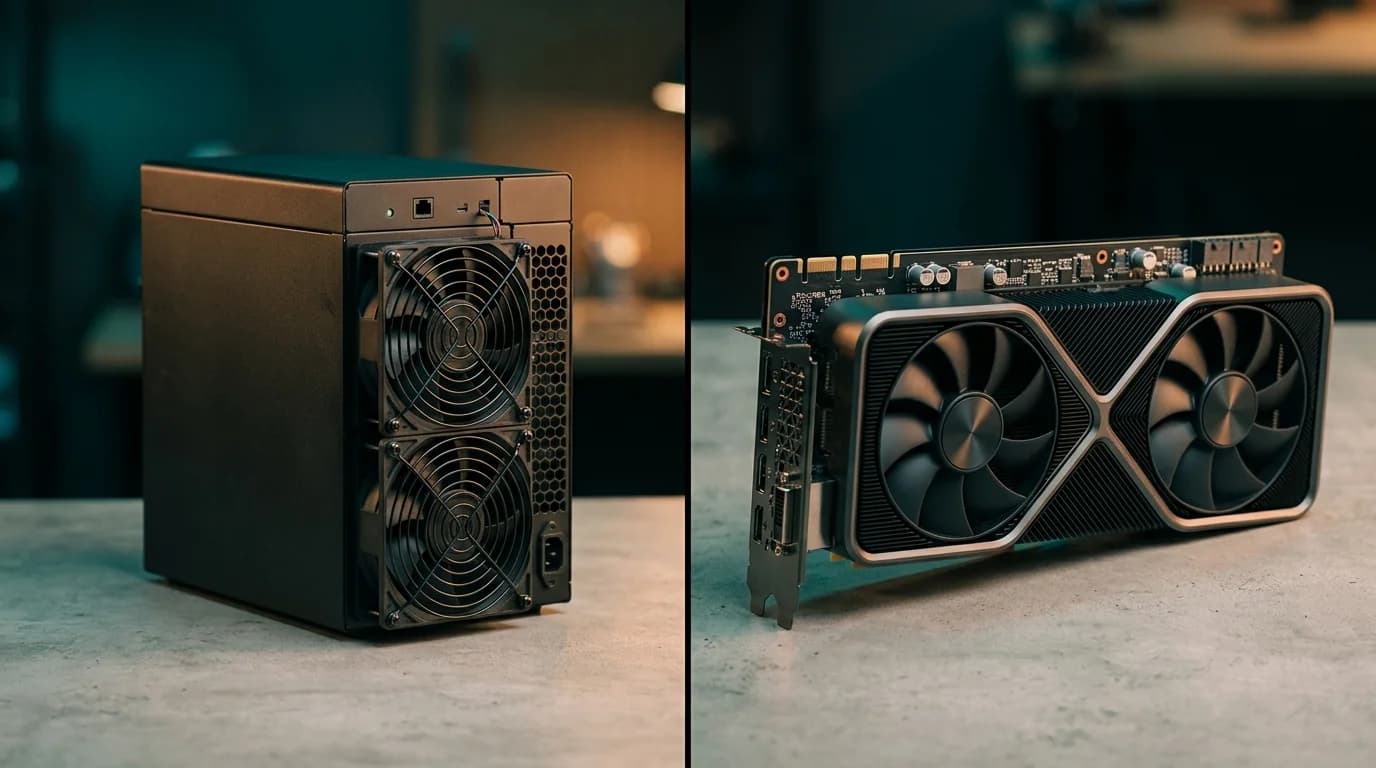
ASIC vs GPU for Bitcoin Mining: Why GPUs Died in 2014
Why the GPU lost the Bitcoin mining war to ASICs in 2014, and what's changed by 2026.
Why does the ASIC beat the GPU on Bitcoin?
Whether you can mine Bitcoin with a GPU has been settled for over a decade. The "why" still matters, because it explains the current structure of the mining hardware market and what to check before buying anything.
Bitcoin uses SHA-256, an algorithm that is simple in computational terms: no memory dependencies, no complex branching, just bitwise arithmetic. That is exactly the kind of workload an ASIC can parallelize to the extreme, because you can stack thousands of identical SHA-256 units on a single chip and run them without any inter-communication.
A GPU is built for more complex workloads: shaders, matrix multiplication, deep learning. It carries a lot of memory, a lot of cores, and a flexible execution pipeline. For SHA-256, all that flexibility is silicon you paid for and never use.
What is the hashrate ratio, ASIC vs GPU?
Antminer S21 Pro (2025): 234 TH/s, meaning 234 × 10¹² hashes per second.
NVIDIA RTX 4090 (top consumer GPU, 2023): about 1 GH/s on SHA-256, meaning 10⁹ hashes per second.
Ratio: 234,000 to 1.
You would need 234,000 RTX 4090s to match the hashrate of a single S21 Pro. At $1,950 per card, that is $456 million of hardware against roughly $6,000 for the S21 Pro. It also ignores the 105 megawatts of grid connection needed to run them.
The ratio gets worse every generation. The RTX 5090 will not multiply its SHA-256 hashrate by 234,000, while the next ASIC generation adds tens of TH/s again.
What is the energy efficiency, ASIC vs GPU?
Hashrate is only half the picture, and the other half decides the bill.
S21 Pro: 3,510 W for 234 TH/s, so 15.0 J/TH (joules per terahash).
RTX 4090: about 450 W for about 1 GH/s, so 450,000 J/TH.
The ASIC is therefore roughly 30,000 times more efficient per hash produced.
Translated into a bill: producing the same quantity of hashes costs 30,000 times more electricity on a GPU. At $0.16/kWh, a common US residential rate, a GPU mining Bitcoin burns more in electricity than it produces in BTC at any price level. No price rally reverses a factor of that size.
Why GPUs left Bitcoin in 2014
At Bitcoin's launch in 2009, mining ran on CPUs. In 2010, Laszlo Hanyecz wrote the first GPU mining code and hashrate jumped. From 2010 to 2013, it was the GPU era.
In January 2013, Avalon shipped the first commercial Bitcoin ASIC. A month later, Butterfly Labs and ASICMiner followed. In 2014, Bitmain launched the Antminer S1: 180 GH/s for 360 W. A single S1 produced as much as a full rack of high-end GPUs of the time, at a fraction of the power draw.
From mid-2014, GPU mining on Bitcoin collapsed. GPU miners had two options: invest in ASICs, or switch to networks whose algorithm deliberately resists ASICs, such as Ethash or Scrypt. Bitcoin has been ASIC-only territory since.
Which coins can you mine on GPU in 2026?
If you already own GPUs and want to put them to work, Bitcoin is not the target. Other networks still accept GPUs.
Ergo (Autolykos2). Memory-hard algorithm, designed to stay ASIC-resistant. Still an active GPU option in 2026.
Ravencoin (KAWPOW). Deliberately ASIC-hostile. Decent GPU performance, profitability tied to price and network hashrate.
Kaspa (kHeavyHash). Recent, still GPU-mineable, but ASICs are arriving on that network. Limited window.
Ethereum Classic (Etchash). The ETC fork still accepts GPU mining. Marginal profitability.
Each of these networks has its own economy. Hashprice there is usually far below Bitcoin's, and token liquidity varies a lot. Before plugging anything in, work out the expected daily revenue at your cards' hashrate, subtract your real electricity cost, and check the token trades on a venue you can actually reach from your country.
What to do with this comparison
If the goal is mining Bitcoin, the ASIC is the only economically viable path: no software optimization, no overclock, and no commercial offer closes a 30,000× efficiency gap. So the decision moves upstream, to the choice of model, site, and electricity rate.
Next steps: the Bitcoin ASIC guide to pick a machine, and ASIC specs explained to read a spec sheet without being misled on J/TH.
Disclaimer: Bitcoin mining carries a risk of capital loss.
Buy or compare through The Bitcoin Bay
The Bitcoin Bay is an independent business introducer: we list new ASICs sourced directly from manufacturers (Bitmain, MicroBT, Bitdeer, Canaan) and refurbished machines via verified reseller partners. Each model is paired with professional hosting options at our partner sites in Northern Europe and Paraguay.
No yield promises, no payment handled on our side — the transaction is signed directly with the chosen partner. CIF/AMF status not solicited.
Related reading
ASIC Fundamentals
Bitcoin ASIC Specs Explained: TH/s, Watts, J/TH, Price
Hashrate, watts, J/TH, $/TH: the four specs that decide a purchase, plus the calculation for the kWh price above which a machine stops earning.
ReadASIC Fundamentals
What Is a Bitcoin ASIC?
A Bitcoin ASIC is a chip dedicated to SHA-256 hashing. It does nothing else, at a speed no other hardware reaches, and it goes obsolete in 24 to 36 months.
ReadMonitoring a Miner: Tools and Metrics
Monitoring a miner means comparing what the machine reports to what the pool counts. The six families of signals to track, and how to read them without blaming the wrong cause.
Read
Frequently asked questions
Why don't GPUs mine Bitcoin anymore?+
Since 2014, ASICs are roughly 234,000× faster in hashrate and 28,000× more efficient. Any GPU mining Bitcoin loses money at all realistic electricity prices.
How many GPUs to match one ASIC?+
You'd need ~234,000 RTX 4090s to match the hashrate of a single Antminer S21 Pro. That's $456 million in hardware vs $6,000.
Which coins to mine on GPU in 2026?+
Ergo (Autolykos2), Ravencoin (KAWPOW), Kaspa (kHeavyHash), Ethereum Classic (Etchash). None has Bitcoin's liquidity or security.
When did the GPU lose to Bitcoin?+
Mid-2014. The Bitmain Antminer S1 (180 GH/s, 360 W, 2014) permanently obsoleted every GPU rig on Bitcoin.
GPU vs ASIC energy efficiency?+
RTX 4090: ~450,000 J/TH on SHA-256. Antminer S21 Pro: 16.5 J/TH. ASIC is roughly 28,000 times more efficient per hash produced.
- [1]Bitcoin Wiki — historical mining hardware comparison
Accessed on 24 mai 2026
- [2]Bitcoin Wiki — GPU mining era data
Accessed on 24 mai 2026
- [3]Cambridge Bitcoin Electricity Consumption Index (CBECI)
Accessed on 24 mai 2026
- [4]Mempool.space — Bitcoin block explorer & network stats
Accessed on 24 mai 2026

slashbin
Builder depuis 2011. J'ai déployé et suivi en direct plusieurs vagues d'ASIC en hosting professionnel sur des sites en Europe du Nord, traversé les halvings au fil des années. Sur The Bitcoin Bay, je pose les chiffres réels, je casse les hypothèses dangereuses, et je mets en relation des projets sérieux avec des hébergeurs vérifiés. Pas de promesse de rendement.
- · Mineur depuis 2011
- · Suivi de déploiements ASIC en hosting professionnel
- · Veille marché ASIC + hashprice hebdomadaire