
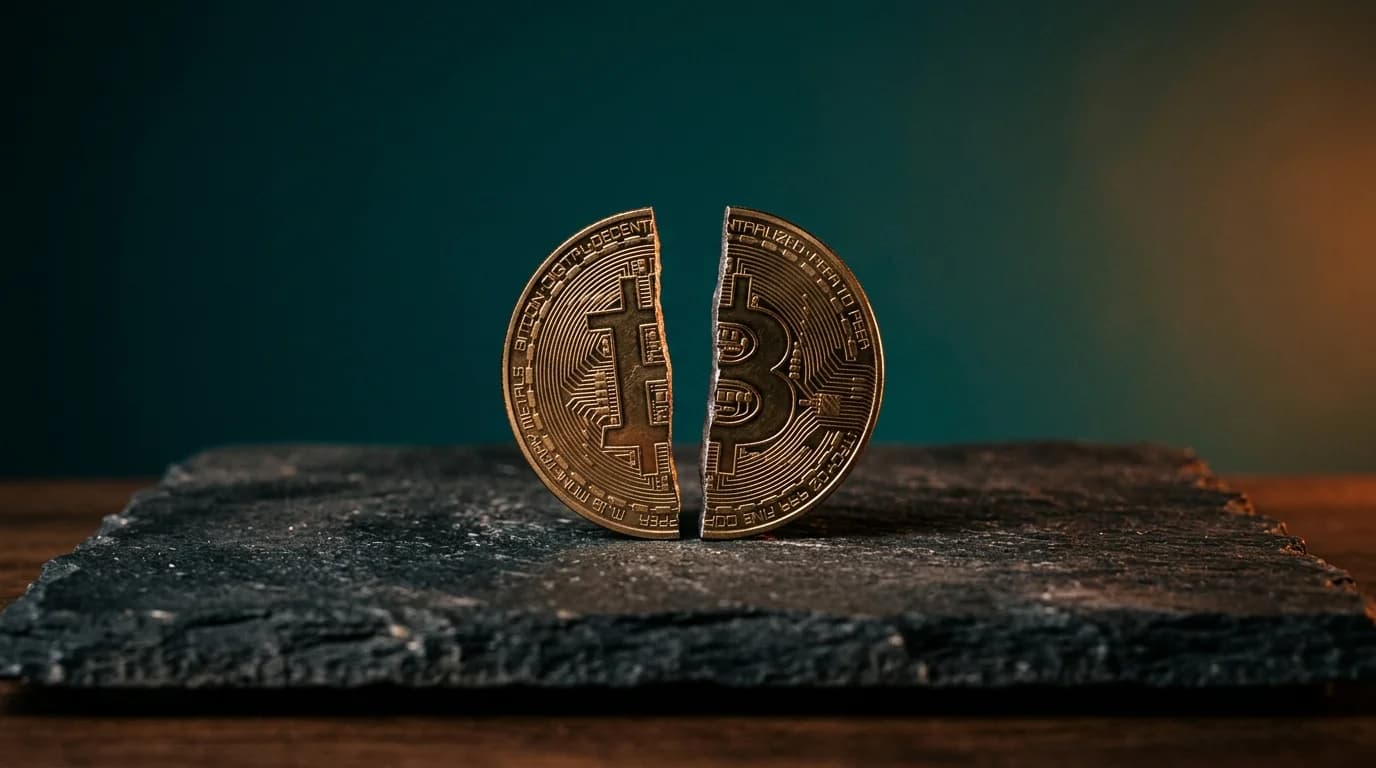
The Bitcoin Halving Explained: Impact on Mining
Understand the halving and its effect on the mining market.
In short. Roughly every four years, the Bitcoin block reward is cut in half. Four halvings have occurred since 2009, from 50 down to 3.125 BTC. The fifth is expected in spring 2028, at 1.5625 BTC. For a miner, each halving forces inefficient hardware offline and durably compresses hashprice. A 2026 ASIC purchase amortized over twenty-four months crosses that date, which makes modelling it mandatory.
The mechanism
Every 210,000 blocks, roughly four years at the ten-minute target, the reward a miner receives for a validated block is cut in half. The rule is written into the protocol and cannot change without a hardfork the entire network accepts.
Why it exists
Bitcoin was designed with a money supply capped at 21 million units. The halving progressively slows issuance to respect that cap without ever reaching it abruptly.
BTC annual inflation follows mechanically:
| Period | Block reward | Annual inflation |
|---|---|---|
| 2020 to 2024 | 6.25 BTC | about 1.8 % |
| 2024 to 2028 | 3.125 BTC | about 0.8 % |
| 2028 to 2032 | 1.5625 BTC | about 0.4 % |
For comparison, monetary inflation in major currencies generally runs between 2 and 8 % per year.
The four past halvings
| Halving | Date | Reward | Hashrate before | BTC price at the date |
|---|---|---|---|---|
| 1 | November 2012 | 50 to 25 BTC | about 25 TH/s | about $12 |
| 2 | July 2016 | 25 to 12.5 BTC | about 1.5 EH/s | about $650 |
| 3 | May 2020 | 12.5 to 6.25 BTC | about 120 EH/s | about $9,000 |
| 4 | April 2024 | 6.25 to 3.125 BTC | about 620 EH/s | about $64,000 |
BTC price rose meaningfully in the twelve to eighteen months following each of those events. Four occurrences do not make a statistical model, and nothing commits the fifth to behaving like its predecessors.
Three concrete effects on operations
BTC revenue is cut in half
At the exact moment of the halving, a miner's BTC revenue halves at constant hashrate. A machine producing 0.001 BTC per month the day before will produce 0.0005 the day after.
The only catch-up runs through a price increase that offsets the reduced issuance. That is what happened historically, without any mechanism guaranteeing it.
Inefficient machines leave the network
Miners running high J/TH hardware, such as S19 units around 27.5 J/TH, become immediately cash-negative after the halving and unplug.
The effect cascades: global hashrate drops, difficulty adjusts downward at the next retarget, and efficient miners see profitability partially recover. That is the network's self-regulation mechanism, and it has repeated at every halving since 2012.
Hashprice stays durably compressed
Hashprice, meaning revenue in dollars per terahash per day, mechanically halves at the event, then partially recovers through the difficulty adjustment. It nevertheless stays structurally below the previous year for six to twelve months.
That compression, more than the halving itself, is what eliminates marginal operators and concentrates profitability on the most efficient fleets.
The next halving
At ten minutes per block and 210,000 blocks between halvings, block 1,050,000 will trigger the fifth, expected between late April and mid-May 2028. The reward will then fall from 3.125 to 1.5625 BTC per block.
If you buy an ASIC in 2026 aiming at a twenty-four month payback, your model crosses that date. At constant hashprice, your BTC revenue halves that day, absent a compensating price move.
Three practical consequences:
- Target efficiency below 12 J/TH, which limits the choice to hydro models such as the S23 Hyd 3U at 9.5 J/TH or the S21 XP Hyd at 12 J/TH.
- Secure an electricity cost below $0.08/kWh, a level almost no residential tariff reaches, hence the move to professional hosting.
- Compute the post-halving break-even before buying, with the reward already halved.
The calculation to run before buying
Take your break-even kWh and halve the hashprice. An S21 Pro, at 15 J/TH and 84.2 kWh per day, earns $11.70 per day at a hashprice of $50/PH/day, giving a break-even of $0.139/kWh. After the halving, at half the hashprice and an unchanged BTC price, that revenue falls to $5.85 and the break-even to $0.069/kWh.
In other words, a machine perfectly viable today at a host charging $0.075/kWh becomes loss-making overnight, with no failure having occurred. That is precisely the calculation most purchase plans omit.
Run it with three explicit assumptions: the future 1.5625 BTC reward, a global hashrate 30 % above today's, and an unchanged BTC price. If the project holds under that scenario, it will probably hold under the others.
A miner's three levers
Optimize J/TH. Refresh hardware every three to four years. S19 units from 2022, around 27.5 J/TH, already sit at break-even in 2026. S21 units at 15 J/TH will hold through the 2028 halving but not beyond at most rates. S23 units at 9.5 J/TH clear the threshold.
Cut the price per kWh. This is by far the most powerful lever. On an S21 Pro drawing 30,748 kWh per year, moving from $0.16/kWh, a common US residential rate, to $0.07/kWh in hosting saves $2,767 per year. That is not a margin improvement: it is what moves the machine from losing $3.46 a day to earning $5.80.
Model before buying, not after. See the ASIC miner ROI calculator for the full method.
Further reading
Any projection about the 2028 halving depends on assumptions that will change. Mining involves a risk of capital loss.
Buy or compare through The Bitcoin Bay
The Bitcoin Bay is an independent business introducer: we list new ASICs sourced directly from manufacturers (Bitmain, MicroBT, Bitdeer, Canaan) and refurbished machines via verified reseller partners. Each model is paired with professional hosting options at our partner sites in Northern Europe and Paraguay.
No yield promises, no payment handled on our side — the transaction is signed directly with the chosen partner. CIF/AMF status not solicited.
Related reading
Fundamentals & Beginners
Bitcoin Mining for Beginners: Where to Start
Four concepts to master, an ASIC between $4,200 and $17,500, and three ways to start. At US residential rates the operation loses money; in hosting it works under conditions.
ReadFundamentals & Beginners
How to Start Bitcoin Mining in 2026 (Step-by-Step)
Six steps: pick the ASIC, secure a wallet, choose a pool, configure the machine, settle home versus hosting, track profitability. Thirty minutes of setup, 29 to 34 months to payback.
ReadMonitoring a Miner: Tools and Metrics
Monitoring a miner means comparing what the machine reports to what the pool counts. The six families of signals to track, and how to read them without blaming the wrong cause.
Read
Frequently asked questions
When is the next bitcoin halving?+
The next halving (5th) is expected between late April and mid-May 2028. It'll cut the block reward from 3.125 BTC to 1.5625 BTC.
What happens to miners at the halving?+
BTC revenue is cut in half overnight. Inefficient miners (high J/TH) go cash-negative and unplug. Difficulty adjusts down, helping efficient miners stay profitable. Hashprice compresses for 6-12 months post-halving.
How many halvings will there be in total?+
About 30 more halvings before the block reward reaches zero (around year 2140). After that, miners are paid only by transaction fees included in blocks.
Does the halving automatically push BTC price up?+
Historically, the 4 past halvings coincided with price appreciation in the 12-18 months following each event. There's no guarantee this pattern repeats — past correlation is not a promise.
How do you prepare for the 2028 halving as a miner?+
Three levers: pick a low-J/TH ASIC (< 12), cut electricity cost via professional hosting, and model post-halving break-even before any purchase. See our ROI calculator guide.
- [1]Bitcoin Whitepaper — Section 6 (Incentive) details the halving mechanism
Accessed on 17 mai 2026
- [2]Bitcoin Core source code — halving implementation in validation.cpp
Accessed on 17 mai 2026
- [3]Hashrate Index — historical hashrate & difficulty data per halving cycle
Accessed on 17 mai 2026
- [4]Cambridge Bitcoin Electricity Consumption Index (CBECI)
Accessed on 24 mai 2026
- [5]Mempool.space — Bitcoin block explorer & network stats
Accessed on 24 mai 2026

slashbin
Builder depuis 2011. J'ai déployé et suivi en direct plusieurs vagues d'ASIC en hosting professionnel sur des sites en Europe du Nord, traversé les halvings au fil des années. Sur The Bitcoin Bay, je pose les chiffres réels, je casse les hypothèses dangereuses, et je mets en relation des projets sérieux avec des hébergeurs vérifiés. Pas de promesse de rendement.
- · Mineur depuis 2011
- · Suivi de déploiements ASIC en hosting professionnel
- · Veille marché ASIC + hashprice hebdomadaire