
How to Start Bitcoin Mining in 2026 (Step-by-Step)
Actionable walkthrough, no fluff.
In short. Six steps: pick an ASIC, set up a wallet, choose a pool, configure the machine, decide on location, then track profitability. Budget thirty minutes of configuration, about $6,000 of capex on a serious machine, and a payback of 29 to 34 months in professional hosting depending on the rate you get. At US residential rates, the operation is almost always unprofitable.
Three realities before you start
Mining does not make you rich quickly. At 2026 hashprice, an Antminer S21 Pro hosted at $0.07/kWh clears about $176 of gross margin per month. Paying back the machine alone, around $6,000, therefore takes about 34 months at that rate, dropping to 29 months at a host charging $0.058/kWh. The entire gap between those two figures comes from the price per kWh.
Electricity is variable number one. For an S21 Pro at 15 J/TH and a hashprice of $50/PH/day, gross margin hits zero at $0.139/kWh. Below that you earn money, above it you lose money every day the machine runs. US residential rates, around $0.16/kWh, sit above that threshold.
Noise and heat are real. An ASIC produces about 75 dB(A) continuously, the level of a vacuum cleaner that never stops, and dissipates 3.5 kW of heat. That is incompatible with an apartment and demanding in a house.
Step 1: pick an ASIC
Three machines cover most situations in 2026:
| Model | TH/s | J/TH | US price | For whom |
|---|---|---|---|---|
| Whatsminer M60S | 172 | 18.8 | about $4,200 | Tight budget, test machine |
| Antminer S21 Pro | 234 | 15.0 | about $6,000 | The default choice |
| Antminer S23 Hyd 3U | 1,160 | 9.5 | about $17,500 | Scaling up, post-2028 horizon |
The criterion that decides is J/TH. Under 12 puts you at the top of the market. Above 20, the machine is economically outdated whatever its purchase price.
For more: best ASIC miners 2026 and buying an ASIC miner.
Step 2: set up a Bitcoin wallet
Three options, in decreasing order of security:
- A hardware wallet such as Ledger, Trezor, or BitBox, for $80 to $150. The private key is never exposed to the internet. That is the minimum once your holdings pass a thousand dollars.
- A software wallet such as Sparrow or Electrum, free and adequate to start, with a migration to hardware planned as soon as payouts accumulate.
- The pool's integrated wallet, convenient but concentrating counterparty risk. Avoid beyond a few hundred dollars.
Write your recovery phrase, twelve or twenty-four words, on paper, in two copies kept in different places. Without it, losing the device makes the BTC permanently unrecoverable, and no support desk can fix that.
Step 3: choose a pool
Four criteria settle it:
- Reputation, with at least three years of operating history. A recent pool that disappears takes unpaid balances with it.
- The payout scheme. FPPS is the 2026 standard: predictable, and it includes an estimate of transaction fees.
- Fees, generally 1 to 2 % of gross revenue. Above 2.5 %, the gap needs justifying by a service the others do not offer.
- The geographic location of the Stratum servers, chosen as close as possible to your machines to limit latency and stale shares.
Stable pools in 2026 include Foundry USA, AntPool, F2Pool, and ViaBTC. Create an account, declare a worker in the format identifier.machinename, and note those credentials: they go into the ASIC's interface.
Step 4: install and configure the machine
- Power. A dedicated 16 A circuit at minimum, 20 A preferably, on its own breaker. Never a power strip: a 3.5 kW machine draws about 15 A continuously, which no domestic strip accepts.
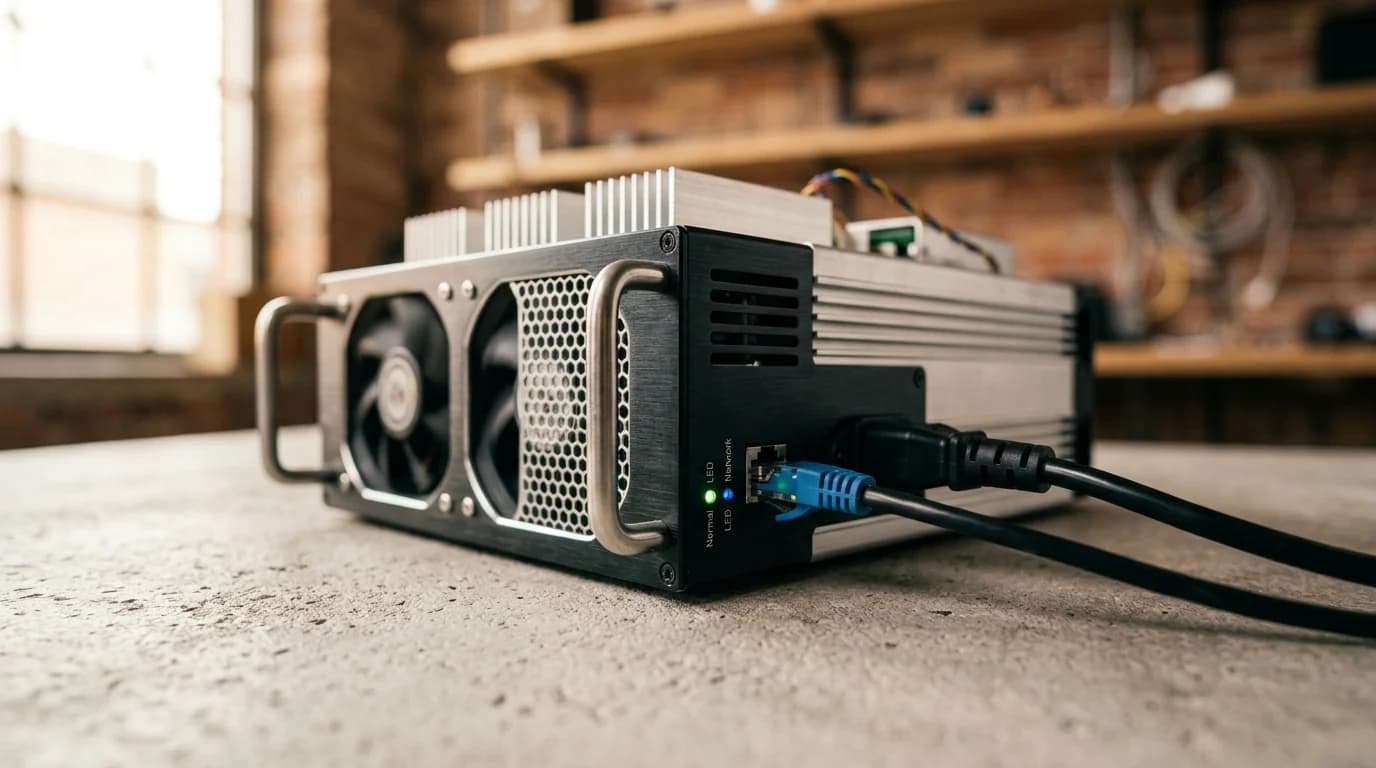
- Network. An RJ45 cable to the router. Wi-Fi is not natively supported and adds latency variance that shows up as stale shares.
- Boot. The machine starts in about two minutes and takes an IP address over DHCP.
- Admin interface. Find the IP from your router and connect. The default Antminer credentials are
rootandroot: change them immediately, before configuring the pool. - Pool configuration. In the miner configuration menu, enter the Stratum URL, the worker, and the password, then save and reboot.
- Verification. After fifteen minutes, hashrate should be stable within ±5 % of nominal, so about 234 TH/s on an S21 Pro, with under 2 % stale shares and temperatures inside the manual's range. Above all, confirm that accepted shares appear on the pool side: that is the only proof the full chain works.
Step 5: home or hosting
Three questions settle it, and two negative answers are enough to make hosting the better option:
- Is your effective rate below $0.10/kWh, all charges included?
- Do you have a space that absorbs 75 dB(A) continuously without becoming a neighbour problem?
- Do you have a dedicated 16 to 32 A circuit, or can you fund the $300 to $900 of electrical work needed?
The detailed comparison sits in hosted vs home mining, and our offers in professional hosting.
Step 6: track profitability
Three tools are enough: the pool dashboard for gross revenue and payouts, a daily hashprice reference such as Hashrate Index, and a personal spreadsheet computing gross revenue minus electricity minus pool fees.
Compare that net against your initial target every week, and rebuild the model completely every one to three months. Hashprice and BTC price drift continuously, and a plan computed once at purchase stops being valid within a quarter.
Five beginner mistakes
Underestimating electricity. A rate quoted at $0.16/kWh often omits fixed charges, taxes, and peak-hour differentials. Take the real amount on your bill divided by the kWh consumed.
Ignoring noise. It is the leading cause of forced resale within three months, generally at a loss.
Skipping the hardware wallet. Keeping several thousand dollars of BTC on a software wallet exposes you to a phishing attack there is no coming back from.
Buying used without verification. Require the operating hours history: beyond 17,000 hours, roughly twenty-four months of continuous running, the machine is probably end-of-life.
Panic selling. Hashprice is volatile and one red month is not a signal by itself. The real question is whether your initial model assumed an 18-month or a 34-month payback, and whether the observed gap falls outside that assumption.
Further reading
- Bitcoin mining for beginners
- Is bitcoin mining profitable in 2026?
- Hosted bitcoin mining
- The catalogue and our hosting offers
Mining involves a risk of capital loss.
Buy or compare through The Bitcoin Bay
The Bitcoin Bay is an independent business introducer: we list new ASICs sourced directly from manufacturers (Bitmain, MicroBT, Bitdeer, Canaan) and refurbished machines via verified reseller partners. Each model is paired with professional hosting options at our partner sites in Northern Europe and Paraguay.
No yield promises, no payment handled on our side — the transaction is signed directly with the chosen partner. CIF/AMF status not solicited.
Related reading
Fundamentals & Beginners
Bitcoin Mining for Beginners: Where to Start
Four concepts to master, an ASIC between $4,200 and $17,500, and three ways to start. At US residential rates the operation loses money; in hosting it works under conditions.
ReadFundamentals & Beginners
The Bitcoin Halving Explained: Impact on Mining
Every 210,000 blocks the reward halves. The next one lands in spring 2028 at 1.5625 BTC: any 2026 ASIC purchase has to model that date.
ReadMonitoring a Miner: Tools and Metrics
Monitoring a miner means comparing what the machine reports to what the pool counts. The six families of signals to track, and how to read them without blaming the wrong cause.
Read
Frequently asked questions
What equipment do I need to start bitcoin mining?+
An ASIC (Application-Specific Integrated Circuit) for SHA-256, a secure Bitcoin wallet (hardware wallet recommended), a mining pool account, and a dedicated 16-32A electrical circuit. Budget $3,000-$5,000 minimum for a current-gen setup.
Do you need to be technical to mine bitcoin?+
No. Initial configuration takes 30-60 minutes: plug the ASIC into your network, enter pool credentials in the admin UI, verify hashrate stabilizes. Daily operation is essentially passive.
How much does an ASIC make per month?+
At 2026 hashprice and $0.07/kWh hosting, an Antminer S21 Pro nets ~$110-$170/month. At US residential $0.14/kWh: marginal. Above $0.15/kWh: often loss-making.
Is bitcoin mining legal in the US?+
Yes. Bitcoin mining is legal in all 50 states. Some states (NY) have moratoria on new fossil-fuel-powered operations, but mining itself is permitted. Income is taxable; consult a tax professional for your situation.
Can you mine bitcoin at home profitably?+
Rarely. US residential kWh ($0.12-$0.18 avg, up to $0.30 in CA) makes most ASICs marginal or unprofitable. Exceptions: low-rate utilities (WA, TX), solar self-consumption, or mining-as-heating in winter.
- [1]Bitmain Shop — official Antminer store
Accessed on 17 mai 2026
- [2]MicroBT Shop — official Whatsminer store
Accessed on 17 mai 2026
- [3]Hashrate Index — daily hashprice reference
Accessed on 17 mai 2026
- [4]Cambridge Bitcoin Electricity Consumption Index (CBECI)
Accessed on 24 mai 2026
- [5]Mempool.space — Bitcoin block explorer & network stats
Accessed on 24 mai 2026

slashbin
Builder depuis 2011. J'ai déployé et suivi en direct plusieurs vagues d'ASIC en hosting professionnel sur des sites en Europe du Nord, traversé les halvings au fil des années. Sur The Bitcoin Bay, je pose les chiffres réels, je casse les hypothèses dangereuses, et je mets en relation des projets sérieux avec des hébergeurs vérifiés. Pas de promesse de rendement.
- · Mineur depuis 2011
- · Suivi de déploiements ASIC en hosting professionnel
- · Veille marché ASIC + hashprice hebdomadaire