
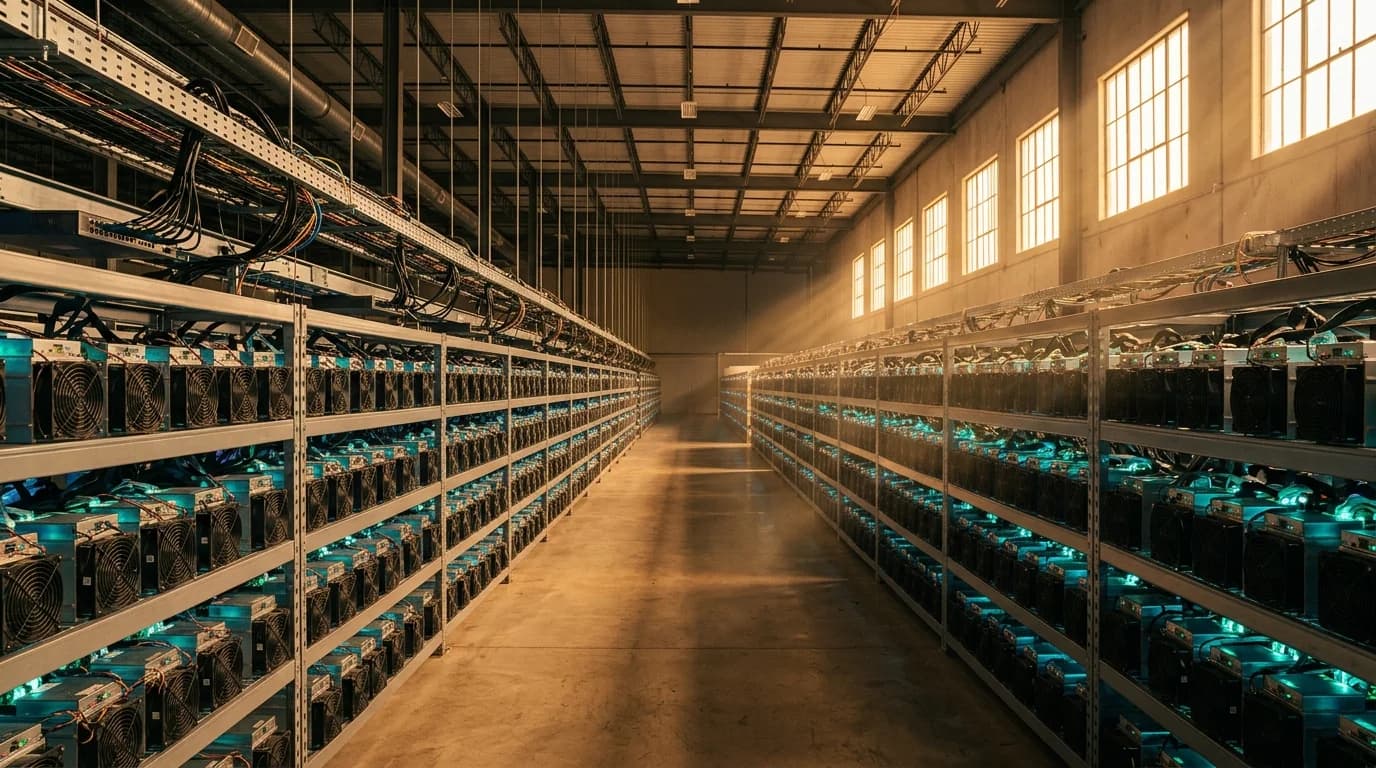
Bitcoin Mining: The Complete Guide (2026)
Everything you need to understand before getting started with bitcoin mining.
In short. Bitcoin mining in 2026 comes down to a single rate gap: $0.07/kWh at a professional hosting facility against a $0.16/kWh US residential average, and considerably more in high-cost states. ASIC choice, pool, and tax structure are second-order optimizations. This guide lays out the numbers and the three paths to participate.
The gap that decides everything
An Antminer S21 Pro produces 234 TH/s drawing 3.51 kW, wherever it is installed. The only variable separating a profitable miner from a loss-making one is electricity cost.
At the median 2026 hashprice of $0.055 per TH per day:
| Effective kWh rate | Daily net margin | Payback on $6,000 |
|---|---|---|
| California residential, $0.30 | −$12.59 | never |
| US residential average, $0.16 | −$0.80 | never |
| Hosting, $0.07 | +$6.78 | about 29 months |
| Paraguay industrial, $0.05 | +$8.47 | about 23 months |
The threshold reads directly: at this hashprice, margin hits zero at $0.150/kWh. The US residential average sits just above it, which is why home mining works only in the cheapest utility markets and fails everywhere else.
That is why the market consolidated across 2024 and 2025 around industrial operators negotiating their kWh directly with utilities. Retail miners in high-rate regions typically quit within six months, their utility bill having absorbed the margin before any amortization.
How it works
Roughly every ten minutes, a miner validates a block and receives the reward, 3.125 BTC since the April 2024 halving, plus that block's transaction fees. That is proof of work.
There is no shortcut: producing a bitcoin requires energy, and that is exactly what secures the network, since an attack would require assembling power comparable to every miner combined.
Hashprice summarizes the equation on the miner's side: daily gross revenue per TH/s, in dollars. In 2026 it oscillates between $0.03 and $0.08 depending on BTC price and difficulty. Track it live on Hashrate Index, and state the value you used in any projection.
The hardware
Four machines dominate the current-generation market:
| Model | TH/s | W | J/TH | US price | Cooling |
|---|---|---|---|---|---|
| Whatsminer M60S | 172 | 3,240 | 18.8 | about $4,200 | air |
| Antminer S21 Pro | 234 | 3,510 | 15.0 | about $6,000 | air |
| Antminer S21 XP Hyd | 473 | 5,676 | 12.0 | about $9,000 | hydro |
| Antminer S23 Hyd 3U | 1,160 | 11,020 | 9.5 | about $17,500 | hydro |
The metric that counts is joules per terahash. The lower it is, the higher the electricity rate a machine tolerates before going cash-negative.
- Under 12 J/TH: top of the 2026 market, margin preserved past the 2028 halving.
- 12 to 18 J/TH: current generation, viable to 2028 at hosting rates.
- Above 25 J/TH: economically outdated, whatever the purchase price.
The detail sits in the best ASIC miners 2026 comparison and the Antminer S21 vs S23 head-to-head.
Pools
Mining solo means waiting months, or years depending on your hashrate, for a single block. A pool combines the hashrate of thousands of miners and distributes rewards in proportion to submitted shares, smoothing revenue without changing its expected value.
The most stable pools in 2026 are Foundry USA, AntPool, F2Pool, and ViaBTC. Typical fees run 1 to 2 % of gross revenue, generally under an FPPS scheme that includes an estimate of transaction fees. The scheme comparison covers which one suits which treasury.
A full profitability calculation
Antminer S21 Pro, twelve months hosted at $0.07/kWh, median hashprice of $0.055 per TH per day.
Revenue. Daily gross comes to 234 × 0.055, so $12.87. Pool fees at 1.5 % take $0.19, leaving $12.68.
Costs. Consumption is 3.51 × 24 = 84.24 kWh per day, so $5.90 of electricity.
Result. Net margin lands at $6.78 per day, about $2,475 per year, and paying back the machine alone takes about 29 months.
The same setup at the $0.16/kWh US residential average gives $13.48 of electricity per day, for a margin of −$0.80 per day, roughly $292 of loss per year before amortization.
The nine-cent gap on the kWh therefore represents about $2,767 of margin per year on a single machine, which exceeds the annual hosting cost in most offers.
These figures depend entirely on the hashprice used. In October 2024 it fell to $0.025 per TH per day: at that level, even $0.07 hosting becomes marginal. Mining therefore assumes long-term conviction on BTC rather than short-term certainty. The full method sits in the ASIC miner ROI calculator guide.
Hosted or at home
Home works in three cases, and no further.
With excess solar self-consumption. Your array produces more than the house draws, and the marginal kWh going to the miner costs nothing. That is the only case where a residential rate stops being an obstacle.
As heating during the cold season. One kilowatt electric produces one kilowatt thermal. If you would heat with electricity anyway, an ASIC replaces the heater while producing BTC on top. The arbitrage holds from October to March and reverses the rest of the year.
As a test rig. A Bitaxe around $150, or a used S9, lets you learn the full chain without committing capital. The purpose is educational, not economic.
Outside those three cases, professional hosting applies. Noise reaches 75 dB(A) continuously, heat to dissipate runs 3.5 kW around the clock, and electrical compliance requires a dedicated 30 A, 240 V circuit. That is unlivable in an apartment and demanding in a house.
For more: hosted bitcoin mining, hosted vs home mining, and colocation costs.
Tax considerations
In most jurisdictions, mined BTC is ordinary income at receipt, valued at fair market value that day. Selling later creates a capital gain or loss against that basis.
- United States: IRS guidance treats mining as self-employment income on Schedule C when it is regular and business-like, or other income on Schedule 1 when it is a hobby. Hosting fees and depreciation are deductible for business filings.
- United Kingdom: HMRC applies a similar split between trading and miscellaneous income depending on scale.
- France: the BNC regime applies, detailed in the French tax guide.
These are general descriptions. Your own treatment depends on your status, your volume, and your history, and it needs validating with a tax professional in your jurisdiction.
Three ways to start
The machine alone. You buy the ASIC and run it where you choose, for a budget of $4,500 to $11,000. This path suits a solar surplus or a heating use. See how to start bitcoin mining and buying an ASIC miner.
Machine plus hosting. The machine ships directly to the partner datacenter, installed and monitored. Budget $4,500 to $11,000 for the hardware and $200 to $350 per month of hosting. It is the simplest path for a first deployment, and our catalogue pairs each model with a verified offer.
Hosting only. You already own machines and hand them to an operator, for $200 to $350 per month depending on the model. See our hosting offers.
In all three cases the same rule applies: start small, measure for six months, then decide whether to grow. Bitcoin is volatile and so are operating conditions, which rules out credit-financed mining.
Our role
The Bitcoin Bay compares hosting operators, cross-checks ASIC specifications against available rates, and connects projects with vetted facilities. The contract is signed directly with the operator.
Bitcoin mining involves a risk of capital loss, and every number on this page depends on hashprice and exchange rate at the moment you read it.
Buy or compare through The Bitcoin Bay
The Bitcoin Bay is an independent business introducer: we list new ASICs sourced directly from manufacturers (Bitmain, MicroBT, Bitdeer, Canaan) and refurbished machines via verified reseller partners. Each model is paired with professional hosting options at our partner sites in Northern Europe and Paraguay.
No yield promises, no payment handled on our side — the transaction is signed directly with the chosen partner. CIF/AMF status not solicited.
Related reading
—
Bitcoin ASIC Miner: The Complete Buyer's Guide (2026)
A Bitcoin ASIC is a chip purpose-built for SHA-256 hashing. In 2026 the leading models reach 9.5 J/TH and cost $3,000 to $18,000 depending on performance.
ReadMonitoring a Miner: Tools and Metrics
Monitoring a miner means comparing what the machine reports to what the pool counts. The six families of signals to track, and how to read them without blaming the wrong cause.
ReadBitmain Logs and Kernel Panic: Diagnostics
Read a Bitmain controller's logs in time order, sort the motif into five families, and treat a kernel panic as a controller halt rather than a mining problem.
Read
Frequently asked questions
How much does bitcoin mining make per month?+
At 2026 hashprice and $0.07/kWh hosting, an Antminer S21 Pro nets ~$110-$170/month. At US residential rates ($0.14/kWh average), it's near break-even. At EU residential rates, often negative. All estimates depend on hashprice, BTC price, and difficulty — which shift daily.
Is bitcoin mining legal?+
Yes in most jurisdictions including the US, UK, EU, and Canada. Income is taxable as ordinary income at receipt (varies by country). Some jurisdictions (China, Algeria, Egypt) ban mining outright. Always check local regulations and tax obligations.
How much does a current-gen ASIC cost in 2026?+
From ~$3,800 (Whatsminer M60S entry-level) to ~$16,500 (Antminer S23 Hydro 3U top-tier) delivered. Sweet spot price/performance is the Antminer S21 Pro at ~$4,500.
How long does it take to recoup an ASIC investment?+
Typical payback in professional hosting at $0.07/kWh: 22-30 months for an S21 Pro, 12-18 months for an S23 Hydro 3U at conservative 2026 hashprice. At US residential rates, often longer or never.
What's the difference between bitcoin mining and cloud mining?+
Mining: you physically own the ASIC, receive mined BTC, pay electricity (or hosting). Cloud mining: you rent unverifiable hashpower from an operator without owning a machine — a sector with a notorious history of scams.
- [1]Bitcoin: A Peer-to-Peer Electronic Cash System — Satoshi Nakamoto
Accessed on 17 mai 2026
- [2]Hashrate Index — Bitcoin mining hashprice & data
Accessed on 17 mai 2026
- [3]ASIC Miner Value — ASIC profitability ranking
Accessed on 17 mai 2026
- [4]Bitmain — Antminer official manufacturer
Accessed on 17 mai 2026
- [5]Cambridge Bitcoin Electricity Consumption Index (CBECI)
Accessed on 24 mai 2026
- [6]Mempool.space — Bitcoin block explorer & network stats
Accessed on 24 mai 2026

slashbin
Builder depuis 2011. J'ai déployé et suivi en direct plusieurs vagues d'ASIC en hosting professionnel sur des sites en Europe du Nord, traversé les halvings au fil des années. Sur The Bitcoin Bay, je pose les chiffres réels, je casse les hypothèses dangereuses, et je mets en relation des projets sérieux avec des hébergeurs vérifiés. Pas de promesse de rendement.
- · Mineur depuis 2011
- · Suivi de déploiements ASIC en hosting professionnel
- · Veille marché ASIC + hashprice hebdomadaire