
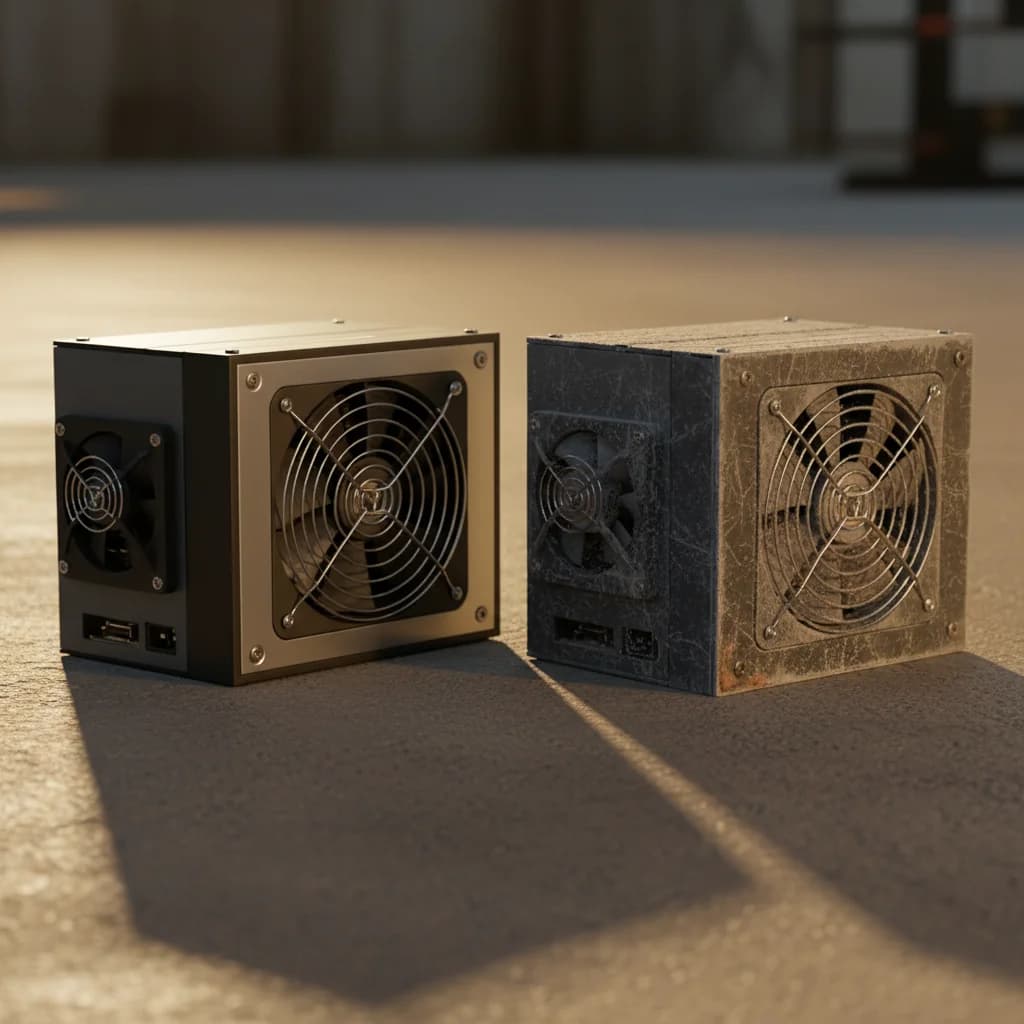
New vs Refurbished ASIC: Which to Buy First
New vs refurbished, by the numbers: thresholds, warranty, how to verify a used machine.
What the premium buys
A new ASIC costs 1.5 to 2 times the price of a refurbished equivalent-generation unit. That premium buys four things: the manufacturer warranty, twelve months at both Bitmain and MicroBT and sometimes extended to twenty-four in a hosting contract; nominal performance on silicon that has not been degraded; stock firmware and support traceable by serial number; and reduced operational risk in the early years.
Against that, refurbished saves 30 to 50 % of the price. A new S19j Pro+ at $3,250 trades between $1,700 and $2,250 used. The warranty falls to zero from a private seller, and to 30 or 90 days at a specialized reseller. Usage history often stays opaque: nothing tells you whether the previous operator ran the machine on permanent overclock.
The rule that holds in every case: buy new as long as a total loss on that machine would put you in difficulty. Once the fleet absorbs a failure without threatening the project, used deserves serious study.
Four cases where new is the right call
It is your first machine. With a single unit, an early failure costs the entire capex and interrupts your learning. The warranty acts as insurance on capital you cannot yet diversify.
You want a recent model. The S21 XP, S23 Hyd, and Sealminer A2 Pro are all but absent from the used market in 2026. Below 15 J/TH the secondary market has almost nothing, and what does circulate sells at new prices.
You have no way to test. Verifying a used machine requires a test bench, diagnostic firmware, and a day of burn-in. Without that you are buying blind, and the used price does not compensate for the uncertainty.
You target more than twenty-four months of operation. Over that span, the manufacturer warranty amortizes its premium by absorbing one or two statistical failures. Over twelve months, the argument weakens considerably.
Four cases where refurbished makes sense
You deploy in volume, beyond five machines. One failure across ten units stays absorbable, and the price gap comfortably covers the risk premium, provided you have a test bench.
You target 25 J/TH or less on a twelve-month horizon. In that envelope, a used S19j Pro+ at $2,000 delivers an aggressive return under $0.055/kWh, precisely because capex is low and the horizon short.
You have the bench and the skills. A 24-hour burn-in, SSH access on stock firmware, real hashrate measurement, and per-hashboard temperature readings catch most defects before payment.
The price drops under $12 to $15 per TH for models of at least 100 TH/s in good condition. At that level, hardware cost becomes secondary to operating cost, and the electricity rate alone decides profitability.
Verifying a used machine: five checks
1. A full burn-in. The machine has to run 24 hours at nominal load with no hashrate drop. A seller who refuses burn-in is refusing the only proof that matters.
2. Effective hashrate against spec. Stock firmware must show at least 95 % of the manufacturer figure, with the machine warm. A gap above 10 % signals failing chips. A drop of roughly a third on a three-hashboard machine signals an entire board out of service, which changes the unit's value completely.
3. Per-hashboard temperatures. All boards should stay within 5 °C of each other at stable load. A board running noticeably hotter signals a near-term failure, even if hashrate looks fine at the moment of testing.
4. Firmware history. Stock firmware is a good sign. A Vnish or Braiins image set to aggressive overclock indicates silicon likely degraded by months of running outside its envelope. Pass, unless the discount is steep and you plan to underclock.
5. Serial number and provenance. A serial traceable at Bitmain or MicroBT lets you verify the production date. The more recent the machine, the higher the price, but the more headroom before economic obsolescence.
Those five checks take a day. Set against a $1,300 discount on an S19j Pro+, they pay for themselves comfortably.
Warranty and after-sales
| Duration | What is covered | |
|---|---|---|
| New, authorized reseller | 12 months Bitmain or MicroBT, sometimes 24 in a hosting bundle | Manufacturing defects, replacement or repair |
| Used, professional reseller | 30 to 90 days depending on the shop | Hidden defects, not normal wear |
| Used, private seller | None | Nothing, sold as-is |
Specialized resellers such as asicminer.fr, ecos.am, or BT-Miners sit in the second row. That warranty gap justifies a real share of the new price on a machine meant to run continuously: across twenty-four months, a single uncovered failure wipes out the saving made at purchase.
Next steps: Used Bitcoin ASIC: Where to Buy for where to look and how to test, and Buying an ASIC Miner for the legal context.
Back to the Bitcoin ASIC guide.
Disclaimer: Bitcoin mining carries a risk of capital loss. Buying used adds a hardware risk that no warranty covers.
Buy or compare through The Bitcoin Bay
The Bitcoin Bay is an independent business introducer: we list new ASICs sourced directly from manufacturers (Bitmain, MicroBT, Bitdeer, Canaan) and refurbished machines via verified reseller partners. Each model is paired with professional hosting options at our partner sites in Northern Europe and Paraguay.
No yield promises, no payment handled on our side — the transaction is signed directly with the chosen partner. CIF/AMF status not solicited.
Related reading
Buying & Market
Bitcoin ASIC Price in 2026: What It Really Costs
A new ASIC costs $25 to $35 per TH in 2026, so $3,250 to $17,500 depending on the model. Price tracks hashprice, amplified by roughly 1.5 times.
ReadBuying & Market
Used Bitcoin ASIC: Where to Buy Without Getting Scammed
Specialized resellers, marketplaces, classifieds, Telegram groups: four channels ranked by reliability, the five common scams, and the 30-minute checklist before you pay.
ReadMonitoring a Miner: Tools and Metrics
Monitoring a miner means comparing what the machine reports to what the pool counts. The six families of signals to track, and how to read them without blaming the wrong cause.
Read
Frequently asked questions
New vs used price gap?+
30 to 50% favoring used. A new S19j Pro+ at $3,250 trades for $1,700–2,250 used at a specialized reseller.
When to buy new?+
First machine, recent model J/TH < 18, no test infrastructure, 24+ month operation horizon. OEM warranty justifies its premium in these cases.
When to buy used?+
Volume > 5 machines, J/TH ≤ 25 and ≤ 12 month horizon, test bench access, price under $12–15/TH. Under these conditions, the delta absorbs the risk.
What warranty on used?+
30–90 days at pro resellers (asicminer.fr, ecos.am, BT-Miners). Zero days from private parties. 24h burn-in mandatory before payment in all cases.
How to verify a used machine?+
24h test bench at nominal load, stock firmware, hashrate ≥ 95% of spec, hash board temps ±5°C, serial number traceable at manufacturer.
- [1]ASIC Miner Value — used market pricing
Accessed on 24 mai 2026
- [2]Hashrate Index — fleet renewal & resale data
Accessed on 24 mai 2026
- [3]Cambridge Bitcoin Electricity Consumption Index (CBECI)
Accessed on 24 mai 2026
- [4]Mempool.space — Bitcoin block explorer & network stats
Accessed on 24 mai 2026

slashbin
Builder depuis 2011. J'ai déployé et suivi en direct plusieurs vagues d'ASIC en hosting professionnel sur des sites en Europe du Nord, traversé les halvings au fil des années. Sur The Bitcoin Bay, je pose les chiffres réels, je casse les hypothèses dangereuses, et je mets en relation des projets sérieux avec des hébergeurs vérifiés. Pas de promesse de rendement.
- · Mineur depuis 2011
- · Suivi de déploiements ASIC en hosting professionnel
- · Veille marché ASIC + hashprice hebdomadaire