
Bitcoin ASIC Miner: The Complete Buyer's Guide (2026)
Everything you need to choose, buy and operate a Bitcoin ASIC in 2026.
What a Bitcoin ASIC is
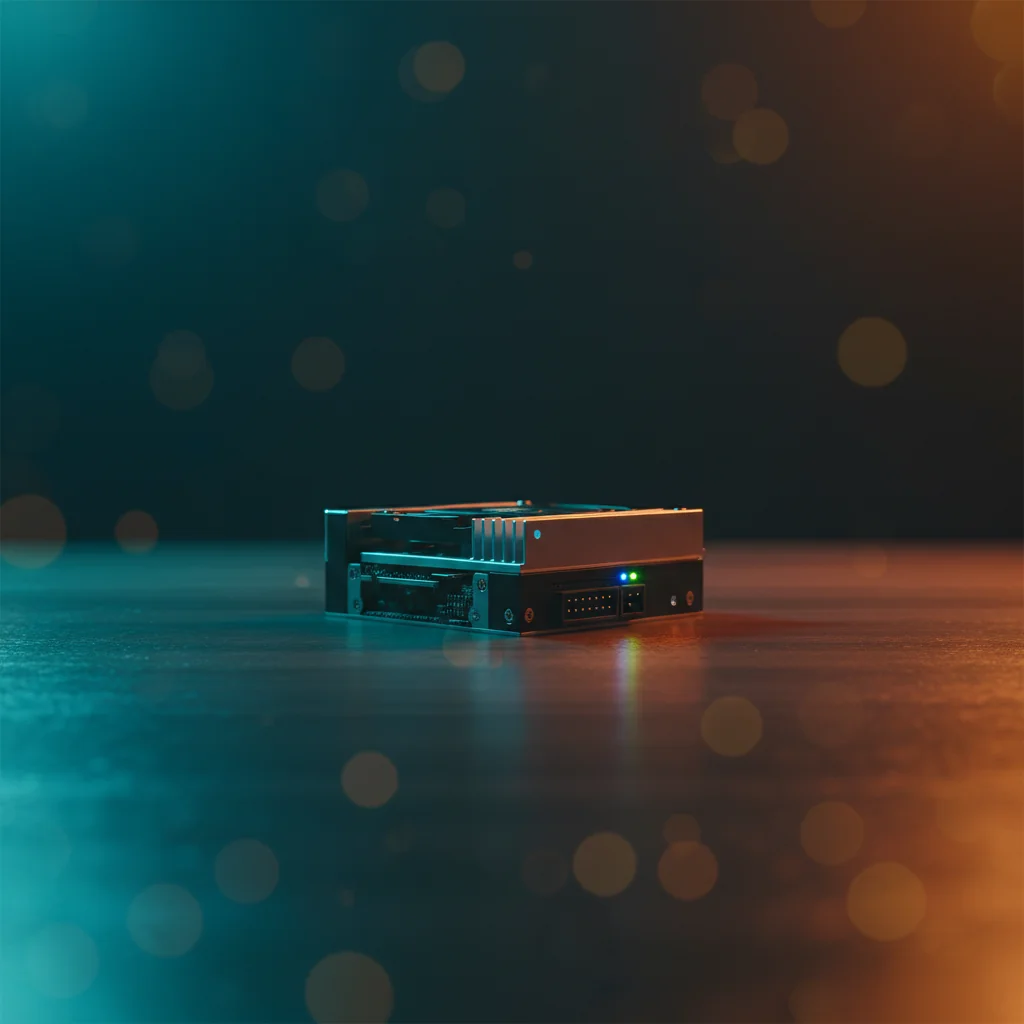
A Bitcoin ASIC is an integrated circuit purpose-built for one task: computing the SHA-256 hash of the Bitcoin protocol. Where a CPU or GPU stays general-purpose, the ASIC gives up all flexibility for raw throughput on that single operation.
The relevant unit is the terahash per second, a trillion attempts per second. In 2026 a high-end ASIC pushes past 1,000 TH/s while the best consumer GPU caps around 1 GH/s, a gap above a million to one.
ASIC stands for Application-Specific Integrated Circuit. The term is not Bitcoin-specific, since ASICs exist for network routing and signal processing, but in crypto "ASIC" without qualifier almost always means a SHA-256 machine, so Bitcoin.
It is not a configurable computer. It is a single-mission machine that becomes economically useless the moment you ask it to do anything else: a Bitcoin ASIC will never mine another algorithm.
Why an ASIC rather than a GPU
Three numbers close the question.
Energy efficiency. An Antminer S21 Pro draws 3,510 W for 234 TH/s, so 15.0 J/TH. An RTX 4090 draws about 450 W for 1 GH/s, so 450,000 J/TH. The ASIC is therefore roughly 30,000 times more efficient per useful calculation.
Raw speed. Even with free electricity, the hashrate gap is 234,000 to 1. In a pool where reward is proportional to contribution, a GPU weighs a negligible fraction.
Cost per unit of capacity. The dollars-per-terahash ratio runs into the hundreds of thousands on a GPU, against $25 to $35 per TH on a new ASIC in 2026.
The full numbers-driven case sits in ASIC vs GPU for Bitcoin Mining.
The four specs that decide
Four numbers on a datasheet determine profitability. The rest is installation detail.
Hashrate, in TH/s. The amount of hashing per second, which sets your share of the blocks the pool finds. An S21 Pro produces 234 TH/s, an S23 Hyd 3U produces 1,160 TH/s.
Power, in watts. Wall-plug draw, which drives your bill. An S21 Pro pulls 3,510 W continuously.
Efficiency, in J/TH. The ratio between those two, and the only figure that compares machines of different sizes. In 2026 the leading models reach 9.5 J/TH on hydro, and good air models sit between 13 and 17 J/TH. Above 25 J/TH, a machine only works with very cheap electricity.
Price per terahash. Under $25/TH the deal is excellent. Between $25 and $35/TH the price is standard on recent new gear. Above $50/TH there is no justification, short of exceptional efficiency.
J/TH deserves particular emphasis, because it converts directly into a break-even threshold. A 15 J/TH machine draws 0.36 kWh per TH per day. At a hashprice of $50/PH/day, each TH earns $0.05, which puts the break-even at $0.139/kWh. A 25 J/TH machine sees that threshold drop to $0.083. That calculation, not hashrate, decides whether your project holds.
The full breakdown sits in Bitcoin ASIC Specs Explained.
The four manufacturers
The SHA-256 ASIC market is concentrated on four players.
Bitmain, founded in Beijing in 2013, remains the historical leader and covers every tier. The Antminer range runs from the now-legacy S19 through the mainstream S21 to the 2026 hydro S23. Distribution is global and support is structured through authorized resellers.
MicroBT, founded in Shenzhen in 2016, is the most serious challenger with the Whatsminer range. The M30S, M50, and M60 are widely deployed in professional hosting. Price per terahash often undercuts Bitmain, with recognized field durability, but longer RMA turnaround.
Bitdeer, based in Singapore and spun out of Bitmain, produces the Sealminer range launched in 2024. The A1 and A2 models compete on efficiency, with a still-recent presence on the retail market.
Canaan, founded in Hangzhou in 2013, produces the Avalon line. Its presence is historical but its market share is receding against the first two.
Other brands, such as IceRiver or Goldshell, target altcoins and fall outside SHA-256 scope.
The 2026 market by tier
Flagship hydro, 9 to 12 J/TH. Antminer S23 Hyd and S23 Hyd 3U, Whatsminer M70S Hydro. From 470 to 1,160 TH/s, between $9,500 and $18,000. These target operators who already run hydraulic infrastructure.
Mainstream air, 13 to 18 J/TH. Antminer S21 Pro and S21 XP, Whatsminer M60S+, Sealminer A2 Pro. From 200 to 270 TH/s, between $5,000 and $8,000. This is the tier of mid-scale air deployments and standard hosting.
Entry-tier air, 18 to 25 J/TH. Antminer S19j Pro+, Whatsminer M50S++. From 100 to 180 TH/s, between $2,700 and $4,800. This tier only justifies itself with very cheap electricity.
Legacy, above 25 J/TH. S19, S19j, and older M30S, viable only under $0.045/kWh or as winter heating. These circulate mainly on the secondary market.
The detailed profitability ranking sits in Best Bitcoin ASICs 2026.
New or refurbished
New costs 1.5 to 2 times refurbished, and that premium buys warranty, nominal performance, and working support.
New is the call if this is your first machine, if you target efficiency under 18 J/TH since those models are scarce used, if you have no way to test, or if you plan more than twenty-four months of operation.
Refurbished holds up from about five machines, when losing one unit stays absorbable, on models at 25 J/TH or better with traceable history, and provided you have a bench allowing a 24-hour burn-in. Expect a 30 to 50 % discount.
The rule that covers it: buy refurbished only what you can afford to lose. Detailed criteria sit in New vs Refurbished ASIC.
Where to buy
The official or authorized distributor stays the safest route: manufacturer warranty, customs compliance, and local support, at full price. European partners such as asicminer.fr, happymining.fr, or captainmining cover the EU.
Specialized used marketplaces, asicminer.fr, ECOS.am, or BT-Miners, sell after burn-in with a limited 30 to 90 day warranty, at 30 to 40 % below new.
Private listings, on Craigslist, eBay, or Telegram groups, show the lowest prices with no warranty at all. A test bench before payment is not optional there.
The legal and tax context sits in Buying an ASIC Miner, and the used market in Used Bitcoin ASIC: Where to Buy.
Operating costs
Purchase price is only part of the equation, and often the smaller part across three years.
Electricity. An S21 Pro draws 3,510 W, so 2,562 kWh per month. At $0.065/kWh that is $167 per month. At $0.16/kWh, a common US residential rate, the bill reaches $410 per month against gross revenue of roughly $356. That single gap is what makes home mining loss-making outside cheap utility markets.
Hosting. Competitive sites charge between $0.058 and $0.078/kWh in 2026 depending on location. The Bitcoin Bay references sites in Iceland, Washington State, Quebec, and Paraguay. See Hosted Bitcoin Mining and Bitcoin Mining Colocation Cost.
Maintenance. Running machines yourself, budget $50 to $150 of parts per machine per year, mostly fans and the occasional hashboard. In hosting, that sits inside the contract.
Tax and financial fees. Currency conversion, wire fees, and VAT depending on your structure. In the US, active mining is generally self-employment income; in France it typically falls under the BNC regime. Validate with an accountant who knows the sector.
How to start
Three entry points, in decreasing order of complexity.
Buy the machine and have it hosted. You buy the ASIC and sign a contract with a hosting site. You carry the hardware risk, the host runs the operation. Budget $3,500 to $18,000 for the machine, plus monthly fees.
Take a machine and hosting bundle. Some operators sell the package to simplify entry. Convenient for a first deployment, provided you check the markup applied to the hardware against distributor pricing.
Go through hosting alone. For anyone who already owns a machine, or who wants to test a configuration before buying. Availability varies by operator.
In all three cases, the first thing to establish is your break-even kWh: without it, none of these options can be compared. See Mining audit for a pre-purchase review.
Disclaimer. Bitcoin mining carries a risk of capital loss. Nothing here is a yield promise or a personalized recommendation. For French tax matters, consult a specialized accountant.
Buy or compare through The Bitcoin Bay
The Bitcoin Bay is an independent business introducer: we list new ASICs sourced directly from manufacturers (Bitmain, MicroBT, Bitdeer, Canaan) and refurbished machines via verified reseller partners. Each model is paired with professional hosting options at our partner sites in Northern Europe and Paraguay.
No yield promises, no payment handled on our side — the transaction is signed directly with the chosen partner. CIF/AMF status not solicited.
Related reading
—
Bitcoin Mining: The Complete Guide (2026)
Mining in 2026 comes down to one gap: $0.07/kWh in hosting against $0.16 US residential average. The real numbers, and the three ways to participate.
ReadMonitoring a Miner: Tools and Metrics
Monitoring a miner means comparing what the machine reports to what the pool counts. The six families of signals to track, and how to read them without blaming the wrong cause.
ReadBitmain Logs and Kernel Panic: Diagnostics
Read a Bitmain controller's logs in time order, sort the motif into five families, and treat a kernel panic as a controller halt rather than a mining problem.
Read
Frequently asked questions
What is a Bitcoin ASIC miner?+
A purpose-built chip for SHA-256 hashing, Bitcoin's proof-of-work algorithm. The only viable hardware to mine Bitcoin in 2026.
How much does a Bitcoin ASIC cost in 2026?+
From ~$3,500 (Whatsminer M50S++ entry) to ~$13,500 (Antminer S23 Hydro 3U flagship), i.e. $23–60/TH. The sweet spot is the Antminer S21 Pro at ~$6,000.
Which ASIC should I buy first?+
For a first purchase in 2026, target an air model at 16–18 J/TH efficiency — Antminer S21 Pro or Whatsminer M60S. Professional hosting mandatory (noise + electricity).
Should I run the ASIC at home?+
No, unless you have dedicated soundproofed infrastructure. 75 dB(A) noise + residential electricity rates make home mining structurally loss-making in most countries. Prefer professional hosting.
ASIC vs cloud mining?+
ASIC: you own the hardware, collect BTC, carry the risk. Cloud mining: you rent hashrate from an operator — often opaque model, frequent scams. Prefer physical ASIC.
- [1]ASIC Miner Value — calculator + live profitability
Accessed on 24 mai 2026
- [2]Hashrate Index — institutional mining market data
Accessed on 24 mai 2026
- [3]Cambridge Bitcoin Electricity Consumption Index (CBECI)
Accessed on 24 mai 2026
- [4]Mempool.space — Bitcoin block explorer & network stats
Accessed on 24 mai 2026

slashbin
Builder depuis 2011. J'ai déployé et suivi en direct plusieurs vagues d'ASIC en hosting professionnel sur des sites en Europe du Nord, traversé les halvings au fil des années. Sur The Bitcoin Bay, je pose les chiffres réels, je casse les hypothèses dangereuses, et je mets en relation des projets sérieux avec des hébergeurs vérifiés. Pas de promesse de rendement.
- · Mineur depuis 2011
- · Suivi de déploiements ASIC en hosting professionnel
- · Veille marché ASIC + hashprice hebdomadaire