
What Is a Bitcoin ASIC?
The definition of an ASIC, how it works, and why it's the only viable hardware to mine Bitcoin.
What a Bitcoin ASIC is
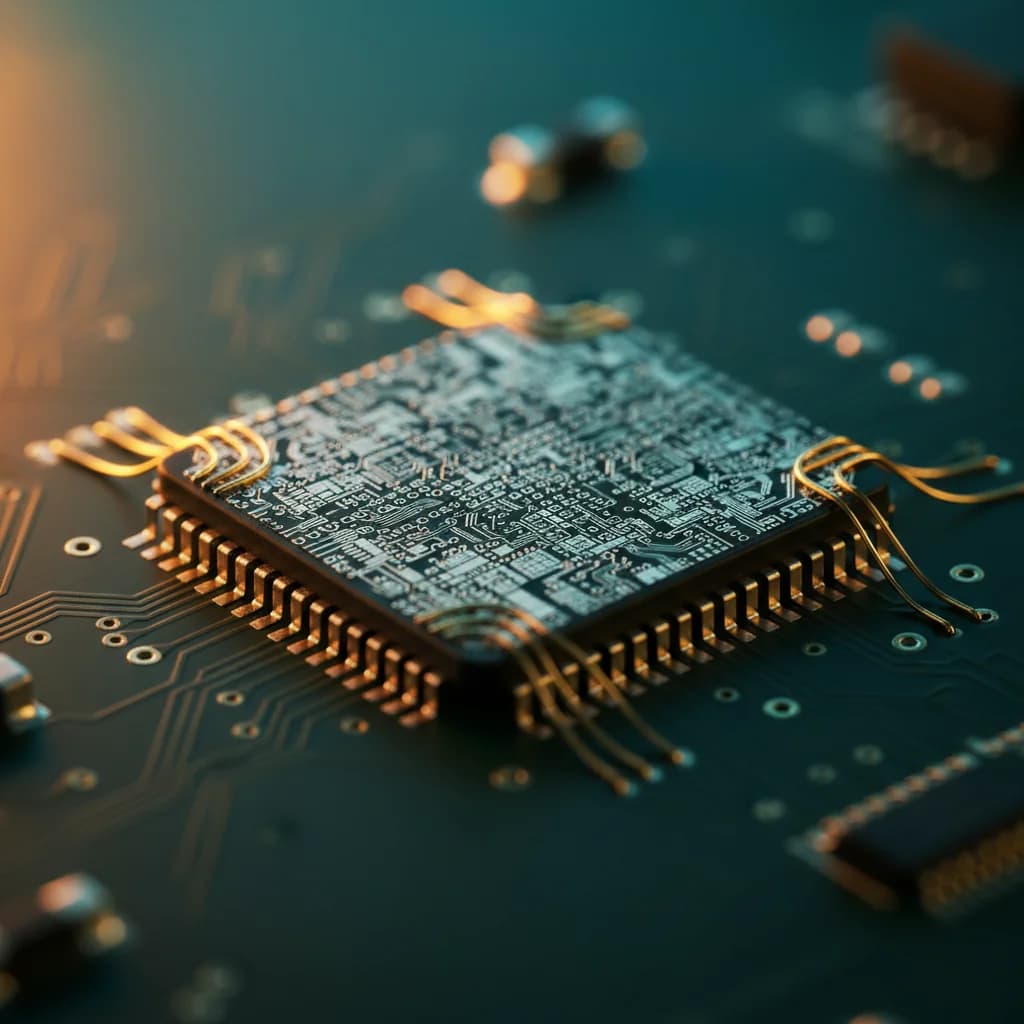
A Bitcoin ASIC is an integrated circuit specialized in computing the SHA-256 hash, Bitcoin's proof-of-work algorithm. It does only that, at speeds no other hardware can reach.
The acronym stands for Application-Specific Integrated Circuit, a chip designed for a single application. That is the opposite of a general-purpose CPU, which handles everything moderately well, and of a GPU, optimized for parallel computing without specialization. An ASIC is a sprinter: it runs in one direction only, but at extreme speed.
In 2026, a modern Bitcoin ASIC produces between 150 and 1,160 terahashes per second, drawing 3,000 to 11,000 watts depending on model and cooling mode. Every element of its design, from the silicon to the firmware through power supply and thermal dissipation, aims to maximize the hashrate-to-watts ratio.
How it works
Bitcoin secures its chain through proof of work. Miners search for a number, the nonce, which combined with the next block header's data produces a SHA-256 hash numerically below a target set by the protocol. The lower that target, the rarer valid hashes become.
Computing a single SHA-256 hash is trivial. What is not trivial is producing trillions per second until one falls below the target.
That is exactly what an ASIC does: it feeds the algorithm varied inputs, rolling the nonce and other permitted header fields, and checks each hash produced. At 234 TH/s, an Antminer S21 Pro performs 234 × 10¹² attempts per second.
When a miner or its pool finds a valid hash, it broadcasts the block and claims the reward, 3.125 BTC since the 2024 halving, plus the block's transaction fees. The race restarts immediately. Network-wide, a block is found on average every ten minutes, so 144 blocks per day.
Why an ASIC beats a graphics card
| Criterion | Antminer S21 Pro | RTX 4090 |
|---|---|---|
| SHA-256 hashrate | 234 TH/s | about 1 GH/s |
| Power | 3,510 W | about 450 W |
| Efficiency | 15.0 J/TH | about 450,000 J/TH |
| Hashrate ratio | 234,000 times | 1 |
| Efficiency ratio | 30,000 times | 1 |
A high-end graphics card produces about 1 GH/s on SHA-256, which is 234,000 times less than a dedicated ASIC, while consuming roughly 30,000 times more energy per hash produced.
At any realistic electricity price the GPU therefore loses outright, and no software optimization closes a gap of that magnitude. The historical detail of the 2014 shift sits in ASIC vs GPU for Bitcoin Mining.
The three major brands
Bitmain, with the Antminer range. Historical leader since 2013. The S19 units have become legacy above 27 J/TH, the S21 and S21 Pro occupy the mainstream between 15 and 17.5 J/TH, and the hydro S23 units form the top tier at 9.5 J/TH. It is the most widely distributed brand, with the best-structured support through its authorized resellers.
MicroBT, with the Whatsminer range. A serious challenger since 2016, through the M50, M60, and M70 series. Its reputation for durability in industrial environments is solid, and its price per terahash often runs 5 to 10 % below Bitmain at comparable performance. In exchange, RMA turnaround is longer.
Bitdeer, with the Sealminer range. Entered the retail market in 2024, with the A1 and A2 series and aggressive efficiency, around 12 to 14 J/TH on the A2. Its commercial presence remains more recent than the first two.
The fourth historical player, Canaan and its Avalon range, has lost market share and is no longer a default reference in 2026.
Three structural limits
Obsolescence. Efficiency improves 30 to 40 % per generation. A 2022 machine is outdated by 2026: at $0.07/kWh, an S19j Pro+ at 27.5 J/TH loses money where an S21 Pro stays positive. Count on 24 to 36 months of productive amortization on a new ASIC, and check that figure against your own rate before buying.
Noise and heat. An air-cooled ASIC produces at least 75 dB(A) at full load, continuously, and dissipates several kilowatts. That is incompatible with a residential setting without dedicated infrastructure, which is why most retail buyers turn to professional hosting.
Failure and resale. An ASIC can fail, usually on a hashboard, the power supply, or the fans. Out of warranty, repair stays possible but technical. Above all, resale value collapses when hashprice falls: the 2022 to 2024 cycle saw drops in the region of 80 %, enough to erase the residual value many financing plans rest on.
Before buying, read the full Bitcoin ASIC guide and run the profitability numbers with your real electricity price, hosting included. Bitcoin mining carries a risk of capital loss.
Buy or compare through The Bitcoin Bay
The Bitcoin Bay is an independent business introducer: we list new ASICs sourced directly from manufacturers (Bitmain, MicroBT, Bitdeer, Canaan) and refurbished machines via verified reseller partners. Each model is paired with professional hosting options at our partner sites in Northern Europe and Paraguay.
No yield promises, no payment handled on our side — the transaction is signed directly with the chosen partner. CIF/AMF status not solicited.
Related reading
ASIC Fundamentals
Bitcoin ASIC Specs Explained: TH/s, Watts, J/TH, Price
Hashrate, watts, J/TH, $/TH: the four specs that decide a purchase, plus the calculation for the kWh price above which a machine stops earning.
ReadASIC Fundamentals
ASIC vs GPU for Bitcoin Mining: Why GPUs Died in 2014
A modern ASIC pushes 234 TH/s, the best consumer GPU about 1 GH/s. That is 234,000 to 1 on hashrate and 30,000 to 1 on efficiency. GPUs keep a use on other networks, not on Bitcoin.
ReadMonitoring a Miner: Tools and Metrics
Monitoring a miner means comparing what the machine reports to what the pool counts. The six families of signals to track, and how to read them without blaming the wrong cause.
Read
Frequently asked questions
What does ASIC stand for?+
Application-Specific Integrated Circuit: a chip designed for one specific application. In Bitcoin mining, refers to a SHA-256 dedicated chip.
ASIC or GPU for Bitcoin?+
ASIC, no contest. Efficiency ratio is ~28,000× in favor of the ASIC. A GPU cannot be profitable on Bitcoin at any positive electricity price.
How many hashes per second does an ASIC produce?+
In 2026, from 100 TH/s (entry-tier) to 580 TH/s (hydro flagship). A terahash = 10^12 hashes per second.
What's typical 2026 efficiency?+
Cutting-edge models hit 9–12 J/TH (hydro). Good air models are at 13–17 J/TH. Above 25 J/TH, economically obsolete unless electricity < $0.045/kWh.
Can an ASIC mine anything other than Bitcoin?+
A SHA-256 ASIC can only mine SHA-256 chains: Bitcoin and forks (Bitcoin Cash, BSV). It CANNOT mine Ethereum, Litecoin, Monero, etc.
- [1]Bitcoin Whitepaper — Satoshi Nakamoto (2008)
Accessed on 24 mai 2026
- [2]Bitmain — manufacturer reference
Accessed on 24 mai 2026
- [3]Cambridge Bitcoin Electricity Consumption Index (CBECI)
Accessed on 24 mai 2026
- [4]Mempool.space — Bitcoin block explorer & network stats
Accessed on 24 mai 2026

slashbin
Builder depuis 2011. J'ai déployé et suivi en direct plusieurs vagues d'ASIC en hosting professionnel sur des sites en Europe du Nord, traversé les halvings au fil des années. Sur The Bitcoin Bay, je pose les chiffres réels, je casse les hypothèses dangereuses, et je mets en relation des projets sérieux avec des hébergeurs vérifiés. Pas de promesse de rendement.
- · Mineur depuis 2011
- · Suivi de déploiements ASIC en hosting professionnel
- · Veille marché ASIC + hashprice hebdomadaire